Build Your 2026 Ecommerce Growth Strategy

You're staring at your Shopify dashboard. Traffic is climbing. Revenue is flat. You've tried a dozen tactics from a dozen blog posts - SEO one month, email the next, a flash sale when things get desperate - and nothing compounds.
The problem isn't the tactics. It's the lack of a systematic ecommerce growth strategy that prioritizes the right moves for your specific business stage.
Every ecommerce business runs on the same equation:
Revenue = Traffic x Conversion Rate x Average Order Value x Purchase Frequency
Most merchants see this and try to improve all four at once. That's a mistake. You end up spreading resources thin, running disconnected experiments, and making marginal progress everywhere while making meaningful progress nowhere.
The better approach: audit your numbers against industry benchmarks, identify the lever that's furthest below where it should be, and focus there until it's healthy. Then move to the next one.
The nine strategies below are ordered by where I'd start for most Shopify stores. Your sequence may differ based on your numbers, but the principle stays the same: one lever at a time, validated with data, until it's healthy.
1. Conversion Rate Optimization - Fix the Bucket Before You Fill It
If your conversion rate is below benchmark, start here. Every improvement multiplies all existing traffic and makes every other strategy more effective.
The average Shopify store converts at 1.4-3%. Top performers hit 4-5%. If you're in the bottom half, you have the most room for improvement - and the highest potential ROI.
What to focus on:
- Trust signals - Reviews, security badges, and return policies displayed where purchase decisions happen (near the Add to Cart button, on the cart page, at checkout)
- Product pages - Benefit-led descriptions, multiple product images, sizing guides, and customer UGC that addresses objections before they become bounces
- Checkout friction - Guest checkout, accelerated payment options (Shop Pay, Apple Pay), and a streamlined flow with three steps or fewer
- Site speed - Sites loading in 1 second convert 3x better than sites at 5 seconds
- Mobile optimization - Mobile drives 73% of ecommerce traffic but converts at roughly half the desktop rate. That gap is revenue sitting on the table.
The key isn't implementing every tactic simultaneously. It's identifying which friction point costs you the most sales and fixing that first.
Further reading: 18 Tactics to Increase Conversion Rate - organized by customer journey stage from first impression to post-purchase.
2. Cart Abandonment Recovery - Stop Losing Sales You Already Won
Seven out of ten shoppers who add items to their cart leave without buying. These aren't cold prospects. They picked products, clicked "Add to Cart," and started the checkout process. Then something pushed them away.
The top reasons are fixable: unexpected costs at checkout (48%), mandatory account creation (26%), and a checkout process that's too long or complicated (22%).
Prevention first, recovery second:
- Show shipping costs early, not as a surprise at checkout
- Enable guest checkout as the default path
- Offer multiple payment methods - digital wallets alone reduce abandonment by up to 21%
- Display a free shipping progress bar in the cart
For carts you don't prevent: A 3-email abandoned cart sequence generates roughly 69% more recovered orders than a single reminder. Send the first within an hour (simple reminder, no discount), the second at 24 hours (social proof, address objections), and the third at 48-72 hours (urgency or a small incentive). Layer in SMS and retargeting ads for higher-value carts.
Even recovering 10% of abandoned carts meaningfully moves revenue - and most stores either don't have recovery flows or send one generic email.
Further reading: How to Reduce Shopping Cart Abandonment - 15 specific tactics with implementation details.
3. Average Order Value - Get More From Every Transaction
Increasing AOV requires zero extra traffic. You're making more from every customer who already decided to buy.
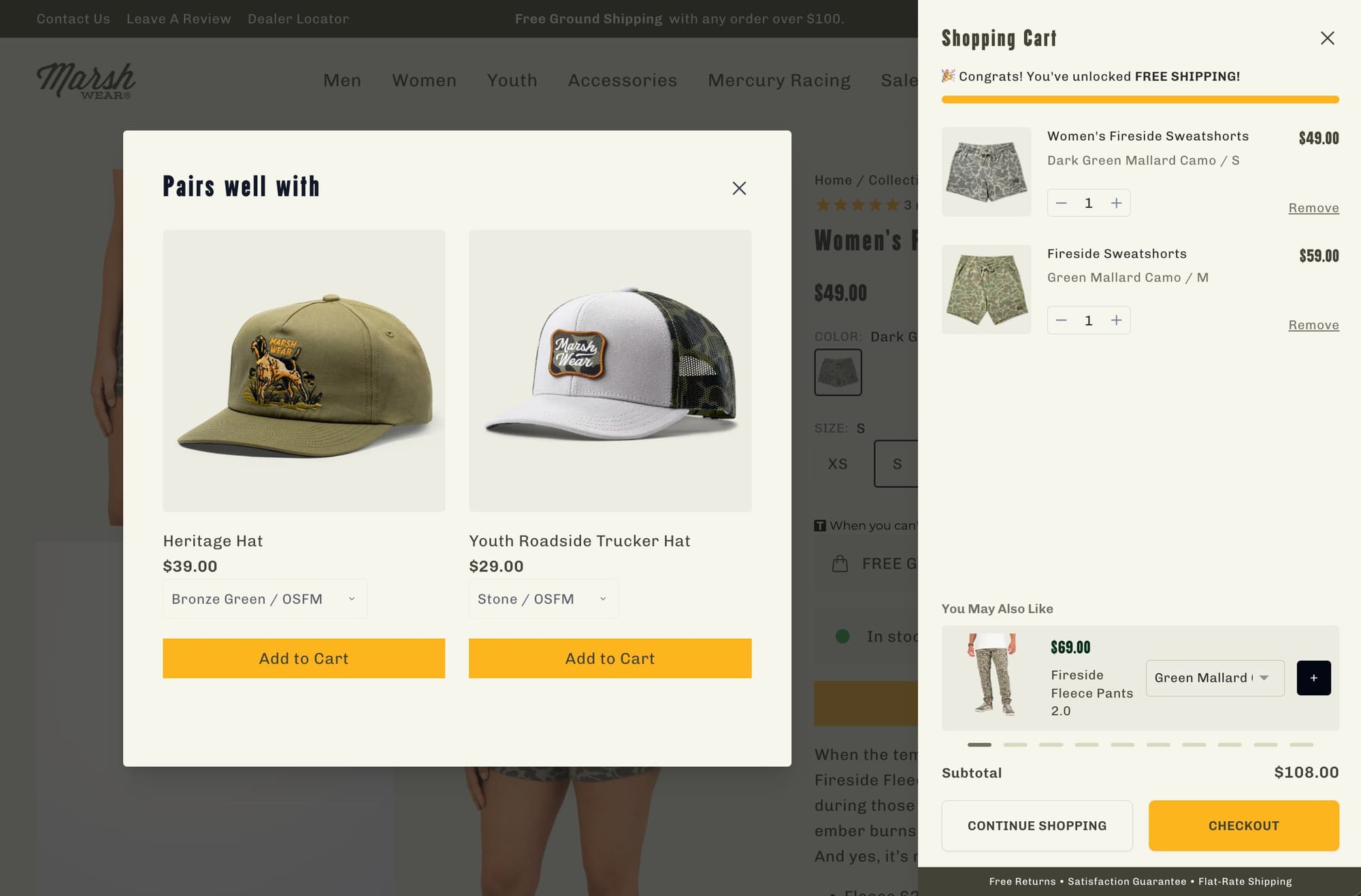
The global average AOV sits around $120-130. If you're below your category benchmark, these are the highest-impact moves:
- Free shipping thresholds - Set yours 20-30% above your current AOV. If your AOV is $75, offer free shipping at $99. "You're $24 away from free shipping" is a strong motivator.
- Product bundles - Pre-package complementary items at a slight discount versus buying separately.
- Cross-sells and upsells - "Frequently bought together" on product pages and "Complete the look" in cart.
- Pricing experiments - This is the lever most stores never touch. We ran a pricing experiment that uncovered $151,840 in annualized hidden revenue - money that was invisible without testing.
Pro Tip: Don't just implement these - test them. I've seen free shipping thresholds backfire when set too high, actually lowering revenue because customers abandoned carts they couldn't hit the threshold on. The goal isn't maximizing AOV. It's maximizing gross profit per visitor.
4. SEO & Content Marketing - Build an Acquisition Channel You Own
Paid ads stop working the moment you stop paying. SEO compounds. Every article you publish, every product page you optimize, every collection page you structure correctly, it accumulates and builds on itself over time.
Customers who search on Google are telling you exactly what they want. They have high intent and are looking for something specific. Your job is to show up when they search.
Where to focus for ecommerce SEO:
- Product and collection pages - Unique descriptions (not manufacturer copy), optimized title tags, and structured data markup for rich snippets
- Blog content targeting buyer intent - "Best [product] for [use case]" and "How to choose [product category]" content captures shoppers mid-decision
- Technical fundamentals - Site speed, mobile-friendliness, clean URL structure, and proper internal linking between related products and content
- Review content as SEO fuel - Customer reviews add fresh, keyword-rich content to your product pages and can trigger review rich snippets in search results
SEO won't deliver results in a week. But six months from now, you'll either have a compounding organic traffic channel - or you'll still be entirely dependent on ad spend that gets more expensive every quarter.
5. Email & SMS Marketing - The Highest-ROI Channel
Email generates $36-42 for every $1 spent. No other marketing channel comes close.
More importantly, you own your email list. No algorithm change can throttle your reach. No platform policy update can cut off access to your audience overnight. That's not true for social media, paid ads, or even organic search.
The flows that matter most:
- Welcome sequence - Introduce your brand, set expectations, and make the first purchase easy
- Post-purchase - Order confirmation (65%+ open rates - use them), shipping updates with care tips, review requests, and replenishment reminders
- Browse and cart abandonment - Recover lost sales with personalized reminders based on actual browsing behavior
- Segmented campaigns - Different messages for first-time buyers, repeat customers, and lapsed customers. Batch-and-blast is dead.
SMS complements email for time-sensitive moments - cart recovery, flash sales, shipping notifications. Keep it to 1-2 messages per week maximum. SMS feels personal, so overuse backfires quickly.
6. Social Proof & Reviews - Let Customers Sell For You
70% of online shoppers check reviews before purchasing. Your customers' words carry more weight than anything you write on a product page.
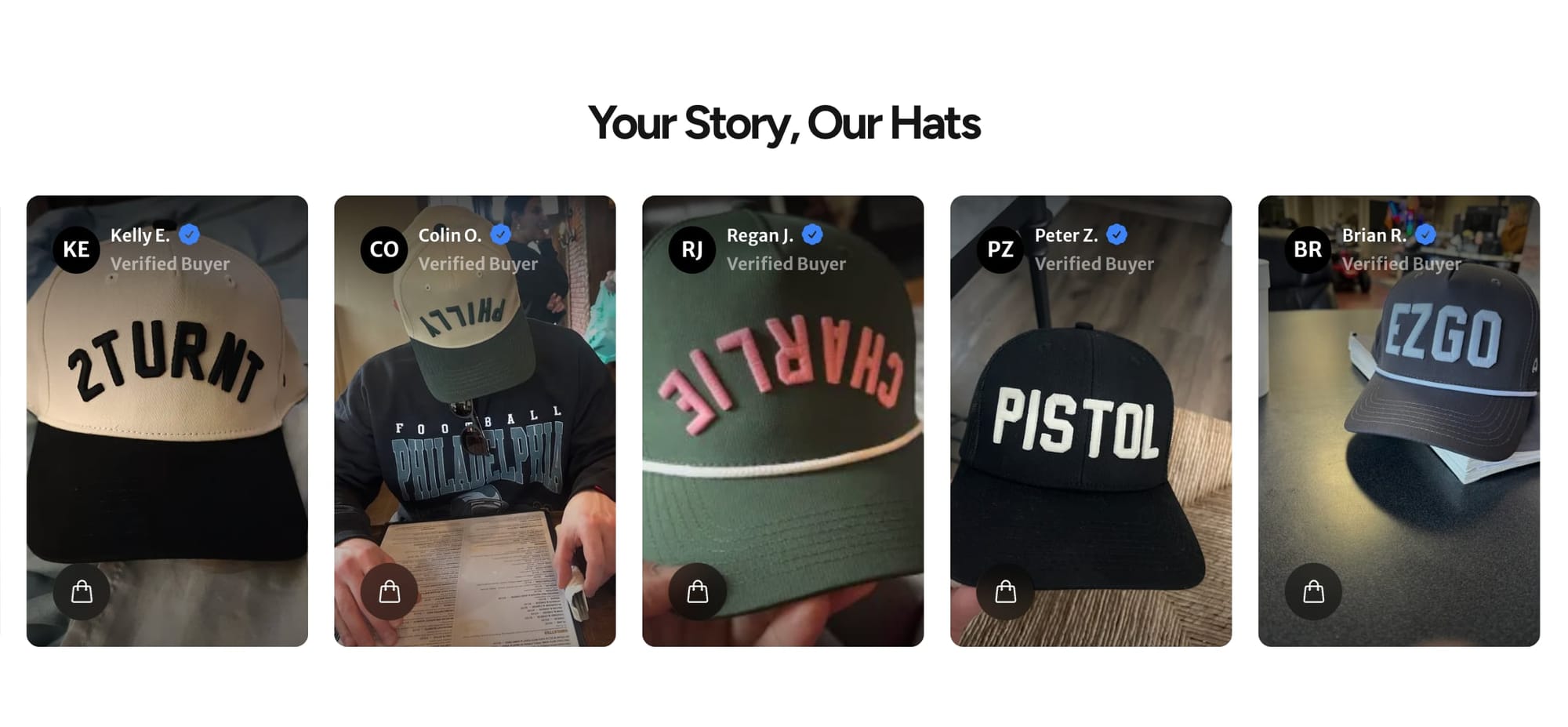
But collecting reviews isn't enough. How and where you display them determines their impact.
What works:
- Show review count and average rating near the product title - not buried below the fold
- Display customer photos (UGC) alongside written reviews
- Surface reviews that address common objections: "I was worried about sizing but it fits perfectly"
- Feature review content in email campaigns and ad creative - social proof converts higher in every channel, not just on product pages
What doesn't: Generic five-star reviews that feel fake, review widgets hidden at the bottom of the page, and aggressive urgency tactics that feel manipulative.
Reviews also feed your SEO. Each review adds fresh, long-tail keyword content to your product pages. Google rewards this with better rankings and review rich snippets that increase click-through rates from search.
7. Customer Retention & Lifetime Value - Make Customers Come Back
Acquiring a new customer costs 5-25x more than retaining an existing one. And repeat customers convert at 60-70% compared to 1-3% for new visitors.
With customer acquisition costs rising 222% in the last decade, the math is clear: retention is how you stay profitable.
Strategies that drive repeat purchases:
- Loyalty programs - Points, tiers, and rewards that give customers a reason to come back instead of comparison-shopping. Make points actually valuable - 1,000 points for $1 doesn't motivate anyone.
- Subscription models - For consumable or replenishable products, subscriptions create predictable recurring revenue and dramatically increase LTV.
- Post-purchase experience - Usage tips, care guides, and check-ins that reinforce the purchase decision and build toward the next one.
- Referral programs - "Give $20, get $20" turns your happiest customers into an acquisition channel. Every referral is a pre-qualified lead with built-in trust.
Benchmark: A healthy LTV:CAC ratio is 3:1 or higher. If you spend $50 to acquire a customer, they should generate at least $150 in lifetime revenue. If your ratio is below that, retention needs attention before you scale acquisition.
8. Paid Acquisition & Social Commerce - Scale What Already Works
Here's where most merchants start. That's backwards.
Paid acquisition amplifies what you already have. If your conversion rate is strong, your AOV is healthy, and your retention keeps customers coming back - paid ads scale profitably. If those foundations are broken, you're paying to fill a leaky bucket.
When you're ready to scale:
- Diversify channels - Meta CPMs have roughly doubled since 2020, from ~$5 to $9-11. Relying on a single platform is a vulnerability. Spread across Meta, Google, TikTok, and emerging channels.
- Social commerce - TikTok Shop and Instagram Shopping aren't just ad platforms anymore. They're sales channels with built-in checkout. TikTok generated $10 billion in consumer spending, and the product discovery features drive impulse purchases at a rate traditional ads can't match.
- Influencer partnerships - 69% of consumers trust influencer recommendations over direct brand messaging. Choose creators who align with your brand values and audience, not just follower count.
- Retargeting - Show dynamic product ads to shoppers who visited but didn't convert. Because they've already shown interest, retargeting delivers higher ROI than cold traffic campaigns.
The metric that matters here: Revenue Per Visitor. A channel with $5 RPV and 1,000 visitors beats a channel with $2 RPV and 2,000 visitors - even though the second channel drove more traffic.
9. Personalization & Customer Experience - Differentiate Beyond Price
You can't out-price Amazon. You can out-experience them.
Personalization isn't just product recommendations (though those alone can drive 10-30% of ecommerce revenue). It's about making every touchpoint feel relevant to the individual shopper.
High-impact personalization moves:
- Product recommendation quizzes - Match shoppers with products based on their needs. This is especially effective for beauty, health, and apparel where choice overload kills conversion.
- Dynamic email content - Different product recommendations, messaging, and offers based on purchase history and browsing behavior.
- Personalized homepage sections - Returning visitors see "Recommended for you" based on past behavior, not the same generic hero banner as everyone else.
- Live chat for high-intent shoppers - Visitors who use site search convert at 2-3x the rate of those who don't. When they can't find what they need, a live chat option (human or AI) captures sales that would otherwise be lost.
Customer service isn't a cost center - it's a growth lever. A well-handled support interaction builds loyalty that no ad campaign can replicate.
Further reading: Customer Experience Optimization: Why It Pays to Invest in CX - how CX improvements translate directly to revenue.
How to Pick Your Starting Point
Don't try to implement all nine strategies simultaneously. That's exactly the scattershot approach this framework exists to replace.
Here's how to prioritize:
- Audit your numbers. Pull your conversion rate, AOV, cart abandonment rate, customer retention rate, and traffic sources. Compare each against industry benchmarks.
- Identify your weakest lever. The metric furthest below benchmark is where you'll get the highest return on effort.
- Prioritize within that lever using the ICE framework. Score potential changes on Impact (1-10), Confidence (1-10), and Ease (1-10). Multiply the scores. Run the highest-scoring changes first.
- Test before you commit. Don't overhaul your entire checkout based on an article you read. Run A/B tests to validate that changes actually improve your numbers before rolling them out permanently.
- Once that lever is healthy, move to the next one. Sequential focus compounds over time - each healthy lever makes the next one more effective.
As a general rule of thumb: fix conversion first, recover abandoned carts, grow AOV, build retention and owned channels (email, SEO), then scale paid acquisition. Your specific numbers might change the order, but the principle holds: fix the foundation before you scale.
What Comes Next?
Growth isn't a one-time project. Customer behavior shifts, competitors evolve, and what worked last quarter might plateau next quarter. The stores that grow consistently treat optimization as an ongoing program - test, learn, implement, repeat.
If you're not sure which lever needs attention first, our free 5-minute AI audit analyzes your customer feedback to surface the objections hurting your conversion rate.
For a deeper analysis, the 148-point CRO audit checklist covers every optimization opportunity across your store.
We run data-driven CRO programs for Shopify stores - identifying which lever to pull, designing experiments, and running A/B tests that validate changes before they go live. $5,950/month, first month free. We've generated over $7.3M in additional revenue for clients with conversion improvements ranging from 57-86%.


