How We Discovered $151,840 in Hidden Revenue

When Quiet Mind came to us, they were running discounts up to 25% without knowing if their baseline pricing was actually optimal. 20 days and one pricing experiment later, we discovered $151,840 in hidden annual revenue and identified a $53,000 profit optimization opportunity.
Here's exactly how we did it—and why pricing experiments should be part of every Shopify store's CRO strategy.
The Pricing Guesswork Problem
Quiet Mind, founded in 2017, built their pricing strategy the same way most ecommerce brands do: competitive benchmarking and educated guesses. They knew their discounts (sometimes up to 25% off) drove conversions. The sales data suggested lower prices worked, but without empirical testing, they couldn't confidently answer:
- Was 25% the optimal discount, or just "good enough"?
- Could a smaller discount (10%? 15%?) achieve similar conversion lifts?
- Were they leaving profit on the table by discounting too aggressively?
Customer reviews confirmed price sensitivity as one of the top three feedback themes. Fluctuating ROAS on paid advertising added urgency—a classic symptom of price-value misalignment.
Mikey, Quiet Mind's owner, needed data to support any pricing decision, especially with investors and third-party resellers watching performance metrics. The strategic thinking was there. The testing capability wasn't.
Why Most Stores Don't Test Pricing
Most Shopify stores never scientifically test their pricing because it's historically been too hard.
Traditional A/B testing platforms create multiple barriers:
- Technical complexity: Requires developer resources for setup and maintenance
- Performance risks: DOM manipulation causes site slowdowns and visual flicker
- Shopify gaps: Price changes must work across product pages, cart, checkout, and BNPL integrations—most platforms weren't built for this
- Resource overhead: For stores with limited SKUs, traditional platforms represent significant investment for uncertain returns
This is why pricing typically defaults to "industry benchmarking + gut feel"—not because store owners don't want data, but because getting reliable pricing data has been prohibitively difficult.
When Shoplift launched their native Shopify price testing feature, it eliminated the technical barriers that kept rigorous pricing experiments out of reach for most stores. We could finally run the pricing experiments we'd always wanted to run.
The Experiment Design
We started with a straightforward hypothesis:
IF we reduce prices by 15% across Quiet Mind's three flagship products
THEN conversion rate increases enough to unlock hidden revenue
BECAUSE current pricing creates barriers that suppress purchase behavior
Why 15%?
Past sales data showed 25% discounts performed well, but we chose 15% for two strategic reasons:
- Statistical significance speed: A more moderate discount reaches significance faster with lower traffic volumes
- Profit preservation: Testing whether we could achieve meaningful conversion lifts without overcorrecting into unprofitable territory
The setup took 15 minutes. No developer resources. No performance concerns. Just native Shopify price testing across product pages, cart, checkout, and all payment integrations.
We launched immediately.
The Results: $151K in Hidden Revenue
The test ran for 20 days with 13,843 visitors. The data revealed exactly the kind of opportunity that had been hidden behind pricing uncertainty:
- Conversion rate: +42.5% (228 vs 159 purchases)
- Revenue per visitor: +33.4% overall
- Returning customer RPV: +62.4%
- Add-to-cart rate: +17.9%
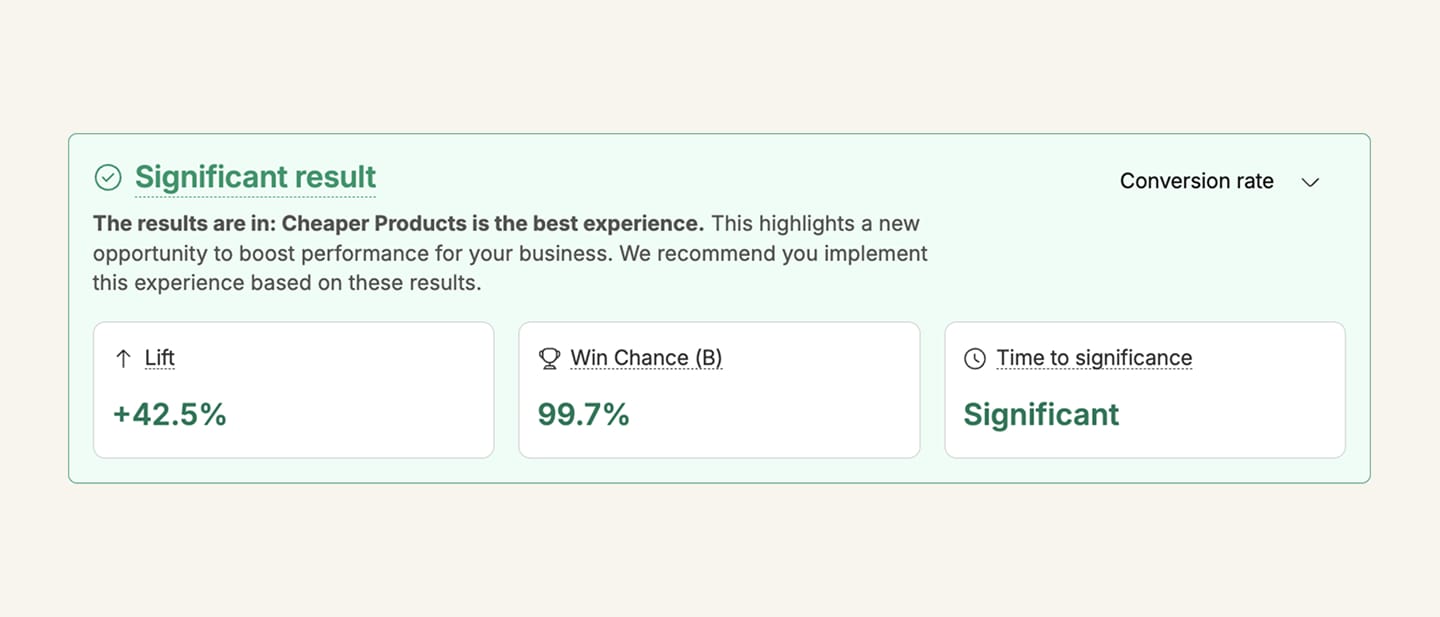
Multiple metrics reached statistical significance. The 15% discount removed a genuine purchase barrier without over-discounting.
Extrapolating the revenue per visitor increase across a full year: $151,840 in additional annual revenue that had been sitting on the table, inaccessible without empirical pricing data.
Taking It Further: Profit Optimization Analysis
Discovering revenue is one thing. Optimizing for profit is another.
Most stores stop at revenue metrics. We took the analysis to the next level by applying a profit optimization framework to the test results.
The Profit Curve Principle
As price decreases, conversion rate increases—but profit follows a curve:
- Initial phase: Profit rises as increased volume compensates for lower margins
- Peak point: The optimal crossover where volume × margin maximizes profit
- Decline phase: Margins get too thin, volume can't compensate, profit drops
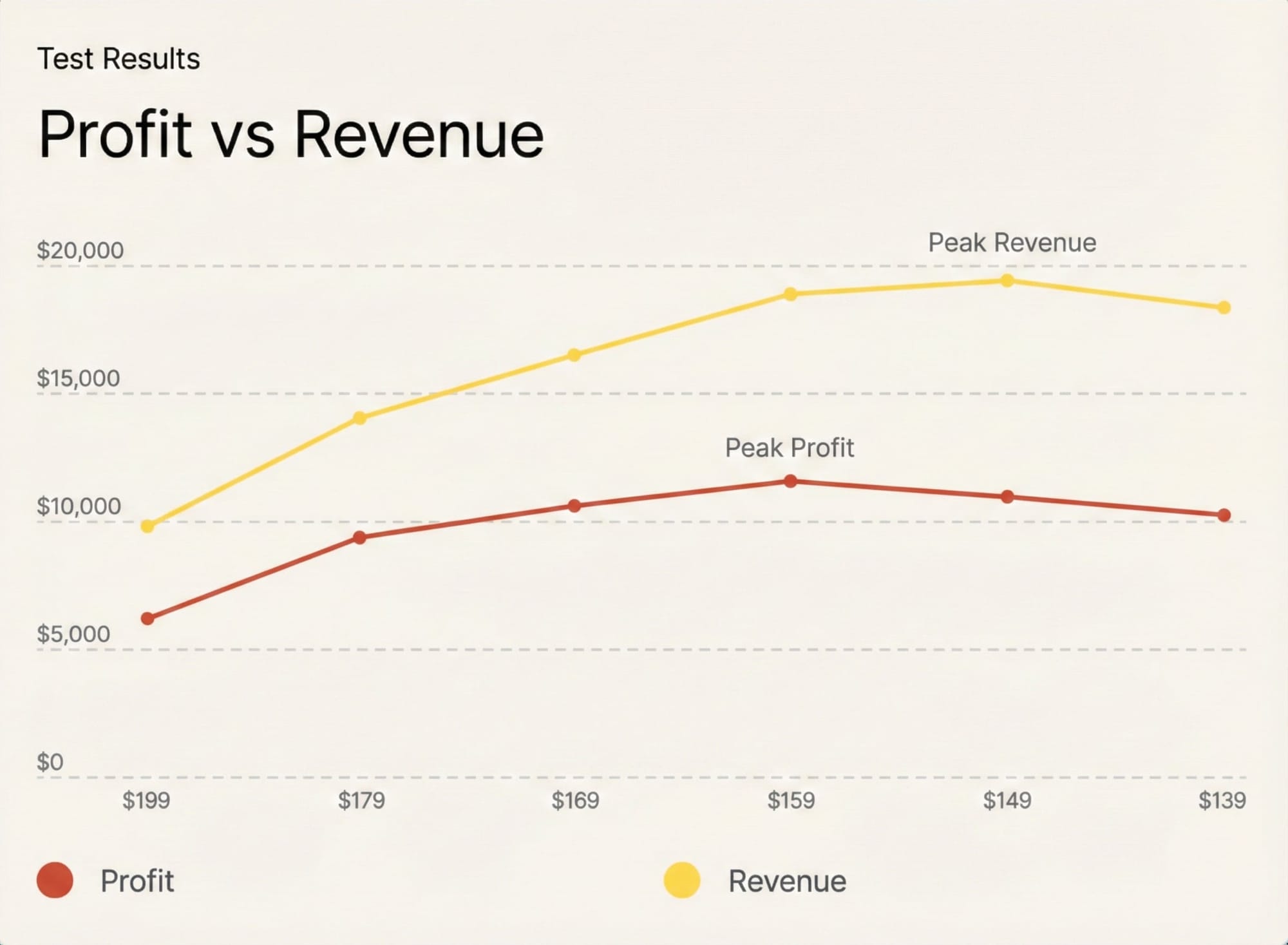
The 15% discount landed Quiet Mind at the optimal crossover point. By analyzing the $151K revenue increase against margin impact, we identified that total profit increased by $53,000 annually.
Lower margins were more than offset by higher conversion. We found the specific price point that maximized profit, not just revenue.
Why This Matters
Revenue metrics alone would have shown the test as successful. But without profit analysis, Quiet Mind could have:
- Discounted too aggressively, winning conversions but killing margins
- Discounted too conservatively, missing the optimal profit point
- Made pricing decisions based on vanity metrics instead of business fundamentals
This is the difference between "running tests" and "systematic conversion rate optimization."
Key Takeaways: Our Pricing Experiment Methodology
After running dozens of pricing experiments across Shopify stores, here's what we've learned:
1. Start with Strategic Hypotheses, Not Random Discounts
Every pricing experiment should answer a specific business question:
- Are we leaving money on the table with current pricing?
- What's the optimal discount level for our customer segments?
- How price-sensitive are our customers actually vs. perceived?
The experiment design flows from the hypothesis. We don't test pricing because we "should"—we test because we have a strategic question that requires empirical data.
2. Test Moderate Changes First
Big swings (30%+ discounts) might win conversions but often destroy profitability. Start with moderate changes (10-20%) to find the efficiency frontier where conversion gains outpace margin losses.
You can always test more aggressive discounting later if data supports it.
3. Run to Statistical Significance
Low-traffic stores often make pricing decisions on insufficient sample sizes. We ran Quiet Mind's test for 20 days to reach significance. Your timeline depends on your traffic, but the principle remains: let the data reach confidence thresholds before drawing conclusions.
4. Analyze for Profit, Not Just Revenue
Revenue metrics are seductive but incomplete. Always calculate the profit impact:
- What's your margin at current pricing?
- What's your margin at test pricing?
- At what conversion rate increase does the test variant become more profitable?
This is basic business math, but surprisingly few stores do it systematically.
5. Price Per SKU, Not Site-Wide Blanket Changes
The next phase for Quiet Mind is individual product testing. Different products have different price sensitivities, value perceptions, and competitive dynamics. Site-wide pricing changes are blunt instruments. SKU-level optimization is where you find the real profit.
The Bigger Picture: Pricing as Competitive Advantage
Most Shopify stores treat pricing as a "set it and forget it" decision informed by competitor stalking and gut instinct. This leaves massive amounts of money on the table—not just from suboptimal prices, but from suboptimal discounting strategies, promotion timing, and product-specific pricing.
Systematic pricing experiments transform pricing from a persistent question mark into a competitive advantage. You're not guessing anymore. You're knowing.
For Quiet Mind, the immediate impact was $151,840 in found revenue and $53,000 in optimized profit. The ongoing value is the capability to ask any pricing question and get definitive answers backed by statistical significance.
What This Means for Your Store?
If you're running discounts or promotions without testing them, you're flying blind. You might be:
- Over-discounting: Winning conversions but destroying margins
- Under-discounting: Preserving margins but suppressing volume
- Mis-timing: Running promotions when pricing adjustments would work better
- Treating all products equally: Missing SKU-specific optimization opportunities
The solution isn't "stop discounting." The solution is "test systematically and optimize for profit."
| Pricing Approach | Business Impact | Risk Level |
|---|---|---|
| Competitor benchmarking | Baseline performance | Medium (might be wrong) |
| Gut instinct discounting | Variable, unpredictable | High (no data) |
| Systematic pricing experiments | Optimized profit | Low (data-driven) |
How We Approach Pricing Experiments
At Clean Commit, pricing experiments are part of our systematic CRO methodology. Here's our framework:
Strategic Assessment
- Audit current pricing vs. competitors
- Analyze customer feedback for price sensitivity signals
- Review historical promotion performance
- Identify specific business questions that require testing
Hypothesis Development
- Define clear success metrics (conversion, revenue, profit)
- Design test variants based on strategic hypotheses
- Calculate required sample sizes for significance
- Set up profit analysis frameworks before launching tests
Test Execution
- Implement tests using Shoplift capabilities (no performance impact)
- Monitor for significance across multiple metrics
- Ensure price consistency across all touchpoints (PDP, cart, checkout, BNPL)
Profit Analysis
- Calculate margin impact at test pricing
- Identify profit optimization point (not just revenue)
- Provide definitive recommendations backed by data
- Plan next-phase SKU-specific testing
This isn't "run some A/B tests and see what happens." It's systematic optimization designed to find the specific price points that maximize your profit.
The Bottom Line
Quiet Mind came to us running discounts without data. Twenty days later, we discovered:
- $151,840 in hidden annual revenue from pricing optimization
- $53,000 in additional annual profit at the optimal price point
- +42.5% conversion rate lift from strategic discounting
- Complete pricing confidence backed by statistical significance
The test setup took 15 minutes. The strategic thinking behind it took years of running pricing experiments across dozens of Shopify stores.
If you're making pricing decisions based on competitor benchmarking and gut instinct, you're likely leaving similar opportunities on the table. The question isn't whether pricing optimization could increase your profit—it's how much profit you're currently leaving behind.
Want to find out? Let's run the experiment.
Ready to Optimize Your Pricing Strategy?
We run systematic pricing experiments as part of our conversion rate optimization service. Our approach combines strategic hypothesis development, rigorous testing methodology, and profit-focused analysis to find the price points that maximize your bottom line.
Our CRO service includes:
- Strategic pricing experiments and A/B testing
- Profit optimization analysis (not just revenue metrics)
- Systematic testing across your product catalog
- Complete implementation with no technical overhead
Learn more about our CRO services →
Related resources:


