12 Key Ecommerce Metrics To Track in 2026

Most store owners drown in dashboards. They track everything, act on nothing, and wonder why growth stalls.
This guide covers the 12 ecommerce metrics that actually move revenue with 2025 benchmarks and how to improve each one.
Jump to a metric:
- Conversion Rate (CR)
- Average Order Value (AOV)
- Customer Lifetime Value (LTV)
- Customer Acquisition Cost (CAC)
- Cart Abandonment Rate
- Add-to-Cart Rate
- Revenue Per Visitor (RPV)
- Return on Ad Spend (ROAS)
- Customer Retention Rate
- Net Promoter Score (NPS)
- Email List Growth & Engagement
- Site Speed Metrics
What Are Ecommerce Metrics?
E-commerce metrics are quantifiable measurements that track your online store's performance across sales, marketing, operations, and customer behavior. They transform raw data into actionable insights.
But here's what most guides miss: not all metrics are created equal.
The difference between a metric and a Key Performance Indicator (KPI) matters:
- Metrics track any measurable business activity (pageviews, bounce rate, time on page)
- KPIs are metrics directly tied to business objectives that warrant immediate action
For example, "website traffic" is a metric. "Revenue per visitor from paid search campaigns" is a KPI that tells you whether your ad spend is actually profitable.
The stores that scale profitably focus on a handful of metrics that move the needle.
The 12 Essential Ecommerce Metrics to Track
We've organized these metrics by business impact, starting with the numbers that most directly affect revenue and working outward.
1. Conversion Rate (CR)
What it measures: The percentage of visitors who complete a purchase.
Formula: (Total Orders ÷ Total Visitors) × 100
2025 Benchmarks:
- Global average: 1.65-2.5% (IRP Commerce reports 1.89%)
- Shopify stores: 1.4% average, 3%+ is top 20% (per LittleData)
- Top performers: 4-5%+
- Amazon: 10-15% overall, 74% for Prime members (per Millward Brown Digital)
Why it matters: Conversion rate is the single most important ecommerce metric because it determines how efficiently you turn traffic into revenue. A store converting at 3% versus 1.5% makes twice as much money from the same traffic.
Benchmarks by industry (Dynamic Yield 2024-2025 data):
- Food & Beverage: 4-6%
- Beauty & Personal Care: 3-5%
- Fashion & Apparel: 2-3.5%
- Electronics: 1-2%
- Luxury & Jewelry: 0.8-1.5%
- Home & Furniture: 1-2%
How to improve it: The most common conversion killers we see in Shopify store audits include:
- Missing trust signals (reviews, security badges, return policy)
- Hidden costs revealed too late (shipping, taxes, fees)
- Weak product pages that don't address customer objections
- Slow site speed (sites loading in 1 second convert 3x better than those at 5 seconds)
The key isn't guessing which fix will work—it's running systematic A/B tests to validate changes before rolling them out permanently. For a deeper dive into specific tactics, see our guide on how to increase conversion rate.
2. Average Order Value (AOV)
What it measures: The average amount customers spend per transaction.
Formula: Total Revenue ÷ Number of Orders
2025 Benchmarks:
- Global average: $120-130 USD
- Fashion/Apparel: $80-120
- Beauty: $50-80
- Electronics: $150-300
- Home & Furniture: $200-400
Why it matters: Increasing AOV is often easier than increasing traffic or conversion rate. If you can get customers to spend 20% more per order, you've effectively given yourself a 20% raise on existing traffic.
How to improve it:
- Free shipping thresholds: Set it 20-30% above your current AOV. If your AOV is $75, offer free shipping at $99.
- Product bundles: Pre-package complementary items at a slight discount versus buying separately.
- Cross-sells and upsells: Recommend relevant products on product pages and in cart.
- Tiered pricing incentives: "Spend $100, get 10% off. Spend $150, get 15% off."
Don't just implement these tactics, test them. We've seen free shipping thresholds backfire when set too high, actually lowering revenue because customers abandoned carts they couldn't hit the threshold on.
3. Customer Lifetime Value (LTV or CLV)
What it measures: The total revenue you can expect from a single customer over your entire relationship.
Formula: Average Order Value × Purchase Frequency × Average Customer Lifespan
Why it matters: LTV determines how much you can afford to spend on acquisition. If your LTV is $500, you can afford to spend more acquiring customers than a competitor with a $100 CLV—even if their conversion rate is higher.
Benchmark: A healthy LTV:CAC ratio is 3:1 or higher. If you spend $50 to acquire a customer, they should generate at least $150 over their lifetime.
How to improve it:
- Increase AOV (more revenue per transaction)
- Increase purchase frequency (email/SMS marketing, loyalty programs, subscriptions)
- Improve retention (better product quality, customer service, post-purchase experience)
Most stores focus obsessively on acquiring new customers while ignoring the gold mine of existing ones. A customer who has bought twice is significantly more likely to buy a third time than a first-time buyer is to return.
4. Customer Acquisition Cost (CAC)
What it measures: The total cost to acquire a new customer.
Formula: Total Marketing & Sales Spend ÷ Number of New Customers Acquired
Why it matters: CAC tells you whether your growth is sustainable. You can grow revenue by pouring money into ads, but if CAC exceeds LTV, you're buying revenue at a loss.
Warning signs:
- CAC increasing quarter-over-quarter without corresponding LTV increase
- Spending more than 33% of first-order revenue on acquisition
- Relying on a single channel where costs are rising (Meta CPMs have roughly doubled since 2020, from ~$5 to $9-11)
How to improve it:
- Improve conversion rate (same ad spend, more customers)
- Improve targeting (fewer wasted impressions)
- Diversify channels (reduce dependence on expensive paid media)
- Leverage organic traffic through SEO and content
- Build referral programs (acquired customers bring more customers)
The stores with the lowest effective CAC typically invest heavily in conversion rate optimization. Improving your site's conversion rate lowers CAC automatically because you get more customers from the same traffic.
5. Cart Abandonment Rate
What it measures: The percentage of shoppers who add items to cart but leave without purchasing.
Formula: 1 - (Completed Purchases ÷ Carts Created) × 100
Why it matters: At 70% abandonment, you're losing $7 of potential revenue for every $3 you capture. Even recovering 10% of abandoned carts can significantly impact revenue.
2025 Benchmarks (Baymard Institute):
- Global average: 70.19% (based on 50+ studies)
- Mobile: 77-80%
- Desktop: 67-70%
- Top performers: 25-40% (yes, even a 60% abandonment rate is considered excellent)
Top reasons shoppers abandon carts (Baymard Institute 2025 research):
- Extra costs too high (shipping, tax, fees) — 48%
- Required to create an account — 26%
- Checkout too long/complicated — 22%
- Couldn't see total cost upfront — 21%
- Didn't trust site with credit card — 18%
- Website errors/crashes — 17%
- Delivery too slow — 16%
- Unsatisfactory return policy — 15%
How to improve it:
- At checkout:
- Show all costs upfront (no surprises at the final step)
- Offer guest checkout
- Reduce checkout to 3 steps or fewer
- Display trust badges and security indicators
- Offer multiple payment options (digital wallets reduce abandonment by 21%)
- After abandonment:
- Abandoned cart emails (39% open rate, 10.7% conversion rate average)
- Send a sequence of 3 emails (generates 6x more revenue than single email)
- Include product images, clear CTA, and consider offering a small incentive in email #2 or #3
For recovery, abandoned cart email sequences are your highest-leverage tool — a 3-email sequence generates 6x more revenue than a single email, with average open rates of 39% and conversion rates of 10.7%.
For a complete breakdown of abandonment causes and proven recovery tactics, check out our guide to reducing shopping cart abandonment.
6. Add-to-Cart Rate
What it measures: The percentage of visitors who add at least one item to their cart.
Formula: (Sessions with Add-to-Cart ÷ Total Sessions) × 100
2025 Benchmark: 7-8% average; 10%+ is strong performance
Why it matters: This is the critical micro conversion that bridges product interest and purchase intent. A low add-to-cart rate signals problems with product pages, pricing, or product-market fit. A high add-to-cart rate with low conversion points to checkout friction.
How to improve it:
- Strengthen product descriptions (address objections, highlight benefits)
- Improve product photography (multiple angles, lifestyle images, zoom capability)
- Add social proof prominently (reviews, ratings, "X people bought this")
- Make the Add to Cart button prominent and above the fold
- Consider sticky Add to Cart on mobile
- Test price presentation (anchoring, payment installments)
7. Revenue Per Visitor (RPV)
What it measures: The average revenue generated per website visitor.
Formula: Total Revenue ÷ Total Visitors
Why it matters: RPV combines conversion rate and AOV into a single metric that tells you the true value of your traffic. This is especially useful when evaluating traffic sources. A channel with lower conversion but higher AOV might actually deliver better RPV.
How to use it: Compare RPV across:
- Traffic sources (organic vs. paid vs. email vs. direct)
- Campaigns (which ads deliver the highest RPV?)
- Landing pages (which entry points convert best?)
- Device types (mobile vs. desktop)
A channel with $5 RPV and 1,000 visitors is more valuable than a channel with $2 RPV and 2,000 visitors, even though the second channel drove more traffic.
8. Return on Ad Spend (ROAS)
What it measures: Revenue generated for every dollar spent on advertising.
Formula: Revenue from Advertising ÷ Cost of Advertising
2025 Benchmarks:
- Break-even: 1:1 to 2:1 (depends on margins)
- Healthy: 3:1 to 4:1
- Strong: 5:1+
Why it matters: ROAS tells you whether your paid acquisition is profitable. But be careful as ROAS without context is misleading and strongly depends on the margins.
A 4:1 ROAS on a product with 25% margins is break-even; on a product with 75% margins, it's extremely profitable.
Beyond ROAS: Consider tracking MER (Marketing Efficiency Ratio), which compares total marketing spend to total revenue rather than attributing specific sales to specific ads. As attribution becomes less reliable, MER provides a more honest picture of overall marketing effectiveness.
9. Customer Retention Rate
What it measures: The percentage of customers who make repeat purchases over a given period.
Formula: ((Customers at End of Period - New Customers) ÷ Customers at Start of Period) × 100
Why it matters: Acquiring a new customer costs 5-25x more than retaining an existing one (per Bain & Company via HBR). A 5% increase in retention can increase profits by 25-95%. Yet most ecommerce brands spend 80%+ of their budget on acquisition.
How to improve it:
- Post-purchase email sequences (thank you, usage tips, replenishment reminders)
- Loyalty programs with meaningful rewards
- Subscription options for consumable products
- Excellent customer service (responsive, empathetic, empowered to resolve issues)
- Win-back campaigns for lapsed customers
10. Net Promoter Score (NPS)
NPS explained
NPS measures customer loyalty with one question: "On a scale of 0-10, how likely are you to recommend us to a friend or colleague?"
Responses fall into three groups:
- Promoters (9-10): Loyal customers who buy repeatedly and refer others
- Passives (7-8): Satisfied but vulnerable to competitors
- Detractors (0-6): Unhappy customers who can damage your brand
Formula: % Promoters − % Detractors = NPS
Benchmarks:
- 0-29: Acceptable
- 30-69: Great
- 70+ : Excellent
Note: Benchmarks vary significantly by industry. A "good" score in telecom differs from retail.
Why it matters: NPS predicts growth. Companies with high NPS grow faster through word-of-mouth, referrals, and repeat purchases. It's also an early warning system—declining NPS often precedes declining sales.
Three common NPS mistakes:
- Ignoring cultural norms - Customers in different regions approach rating scales differently, skewing results for global brands
- Skipping benchmarks - Compare against industry standards and track internally at least every 6 months
- Not asking follow-up questions - Add an open-ended "What's the main reason for your rating?" Use skip logic to tailor questions: ask promoters what they love, ask detractors what was missing
How to improve NPS:
- Use detractor feedback to identify customer journey pain points
- Identify promoters and program referral program around them
- Track changes after CX improvements to measure impact
11. Email List Growth & Engagement Metrics
Key metrics:
- List growth rate: (New subscribers - Unsubscribes) ÷ Total subscribers
- Open rate: Percentage of recipients who open emails (benchmark: 20-25%)
- Click-through rate: Percentage who click a link (benchmark: 2-5%)
- Conversion rate: Percentage who complete a purchase (benchmark: 1-5%)
- Revenue per email: Total revenue ÷ Emails sent
Why it matters: Email is the highest-ROI marketing channel for most ecommerce stores, generating $36-42 for every $1 spent (per Litmus). Unlike paid media, you own your email list, it's an asset that compounds over time.
12. Site Speed Metrics
Key metrics:
- Page load time: Time until page is fully loaded (benchmark: under 3 seconds)
- Largest Contentful Paint (LCP): Time until main content is visible (benchmark: under 2.5 seconds)
- First Input Delay (FID): Time until page is interactive (benchmark: under 100ms)
Why it matters:
- 53% of mobile visitors leave pages that take longer than 3 seconds to load (Google)
- Sites loading in 1 second have a 3x higher conversion rate than sites at 5 seconds (Portent)
- The BBC loses 10% of users for every additional second of load time
- Google uses Core Web Vitals as a ranking factor
Site speed is an often overlooked conversion factor. Before you test new layouts, offers, or copy, make sure your site loads fast enough that visitors actually see them.
Shopify Analytics: Where to Find These Metrics
If you're running a Shopify store, you have access to built-in analyticsthat track most of these metrics automatically.
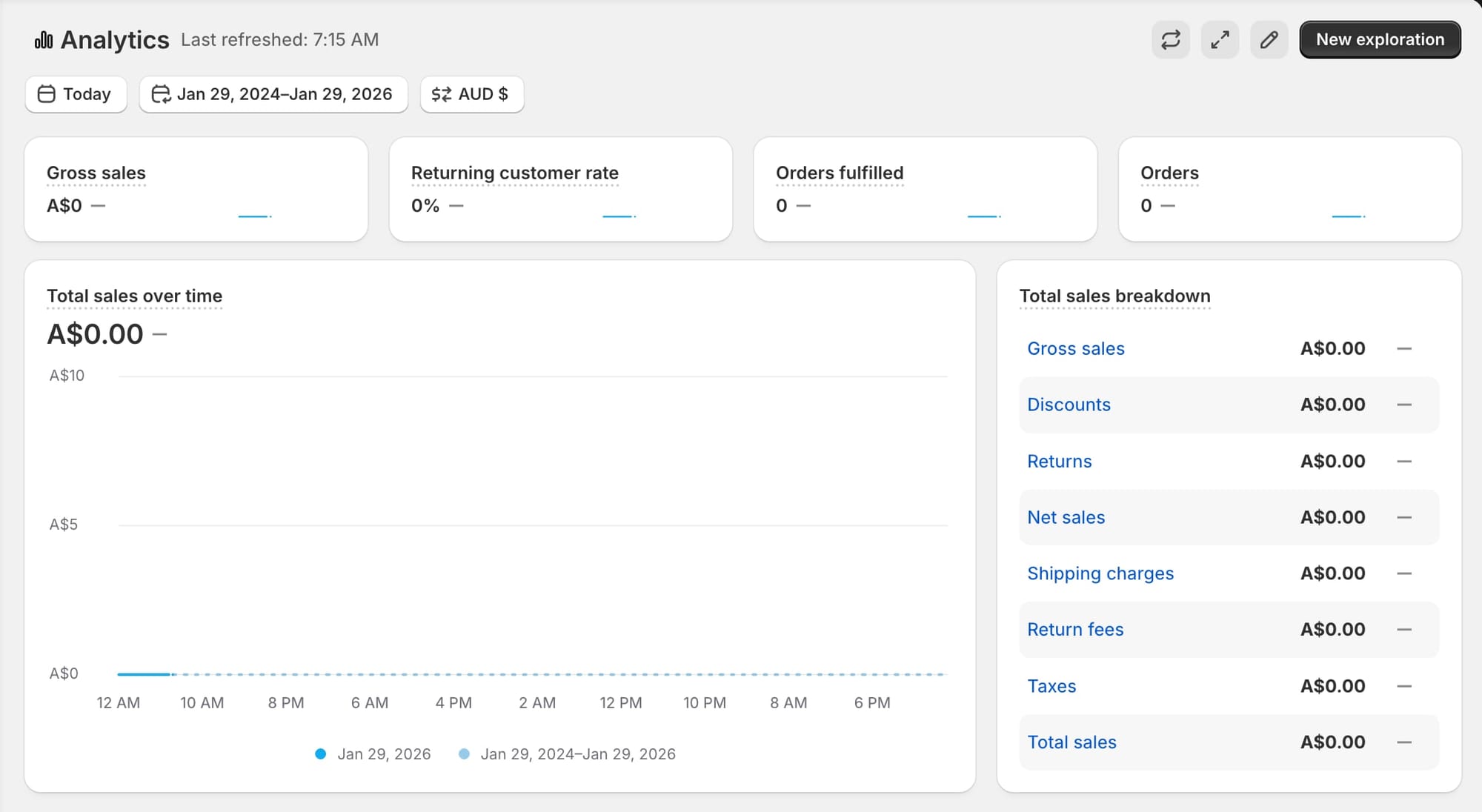
In Shopify Admin → Analytics:
- Total sales and orders
- Conversion rate (Online store conversion rate)
- Average order value
- Returning customer rate
- Top products, traffic sources, and landing pages
What you'll need additional tools for:
- Detailed funnel analysis → Google Analytics 4 or Rybbit
- Heatmaps and session recordings → Microsoft Clarity or Hotjar
- A/B testing with statistical significance → Shoplift
For a full evaluation, our 148-point CRO audit checklist covers every optimization opportunity.
How Often Should You Review Metrics?
| Frequency | Metrics | Why |
|---|---|---|
| Daily | Revenue, orders, conversion rate | Catch issues immediately |
| Weekly | Traffic by source, cart abandonment, AOV, top products | Spot trends and weekly patterns |
| Biweekly | CAC, ROAS by channel, email performance | Allow enough data to be meaningful |
| Monthly | Retention rate, NPS, CAC | Longer-term strategic metrics |
| Quarterly | LTV:CAC ratio, LTV, site speed, year-over-year comparisons, channel mix | Strategic planning and budget allocation |
Pro tip: Set up automated alerts for significant deviations. If conversion rate drops 20% day-over-day, you want to know immediately—not at your weekly review.
Start with Most Impactful Metrics
You don't need to track all 12 metrics perfectly from day one. Start with the big three:
- Conversion rate — Are you turning visitors into customers?
- Average order value — Are customers buying enough per transaction?
- Customer acquisition cost — Can you afford to acquire these customers?
If these are healthy, your business is fundamentally sound. If any is broken, fix it before optimizing everything else.
Need help identifying which metrics need the most attention in your store?
Our free 5-minute AI audit analyzes your customer feedback to surface the objections that might be hurting your conversion rate. Or explore how systematic A/B testing can help you improve every metric through validated experiments rather than guesswork.
We also offer free trials for conversion rate optimization services for Shopify merchants.
Frequently Asked Questions
What is the most important ecommerce metric?
Conversion rate is typically the most important single metric because it directly determines how efficiently you monetize traffic. However, the "most important" metric depends on your current bottleneck. If conversion rate is strong but customers never return, retention rate matters more.
What is a good conversion rate for Shopify?
The average Shopify conversion rate is 2.5-3%. Stores converting above 3% are in the top tier, while 4-5%+ indicates excellent optimization. However, benchmarks vary dramatically by industry—luxury stores may perform well at 1.5% while food/beverage stores should target 4%+.
How do I track ecommerce metrics in Shopify?
Shopify's built-in analytics (Admin → Analytics) tracks sales, conversion rate, AOV, returning customers, and traffic sources. For deeper analysis, integrate Google Analytics 4 for funnel visualization and Microsoft Clarity for behavior analysis. Use dedicated A/B testing tools to validate changes.
What's the difference between metrics and KPIs?
Metrics measure any business activity (pageviews, bounce rate). KPIs (Key Performance Indicators) are the specific metrics tied directly to strategic business objectives that warrant immediate action and resource allocation.
How often should I check my ecommerce metrics?
Check revenue and conversion rate daily to catch issues early. Review traffic, cart abandonment, and AOV weekly. Analyze CAC, ROAS, and retention monthly. Evaluate CLV:CAC ratios and strategic metrics quarterly. Set up automated alerts for significant deviations.
What causes low conversion rates?
Common causes include: hidden costs at checkout (48% of abandonment per Baymard Institute), mandatory account creation (26%), complicated checkout (22%), lack of trust signals, slow site speed, poor product pages, and misaligned traffic (visitors who aren't your target customer).


