 Talk to a human
The 12 Psychological Reasons Customers Actually Buy

About a year ago we started running out of good test ideas for a long-term CRO client.
We were still finding friction. Still fixing unclear copy, confusing navigation, all the regular stuff that shows up in every audit.
But those wins have a ceiling.
I was working with a brand where it was obvious something else was going on. Most of the buyers were parents, and the reviews were loaded with emotion that had nothing to do with page speed or button placement. People weren't hesitating because the checkout was clunky. They were hesitating because the purchase meant something.
So I went down a rabbit hole.
I'm tertiary qualified in psychology (it's the degree I actually finished before falling into web development), and this is the kind of problem that gets me properly excited. I pulled up the big psychology papers on human motivation, the ones the marketing world barely touches, and started figuring out how to turn them into something we could actually use on a client's reviews.
What came out the other end is a 12-point framework we now run on every client's customer base. We scrape everything people have said about a brand online, code it against these 12 motivators, and rank which ones are actually driving the purchase.
This post is that framework. All 12 of them, what they mean, and one result that convinced me this wasn't just an academic exercise.
Why Do Friction Fixes Stop Working?
For the first few years of doing this, most of what moved the needle was obvious once you looked for it.
Confusing navigation. Slow page speed. A CTA that blends into the background. Copy that doesn't answer the question a visitor actually has.
We built a lot of our process around fixing exactly this stuff, and it's still where I'd tell anyone to start (18 tactics to increase conversion rate covers most of it). But once you've been running tests on a store for a while, you hit the same wall every time. The obvious friction is gone. The clarity issues are fixed. And the next round of test ideas start looking thinner and thinner, which is basically the problem I kept running into when picking tests that actually move revenue.
That's where the parent brand came in.
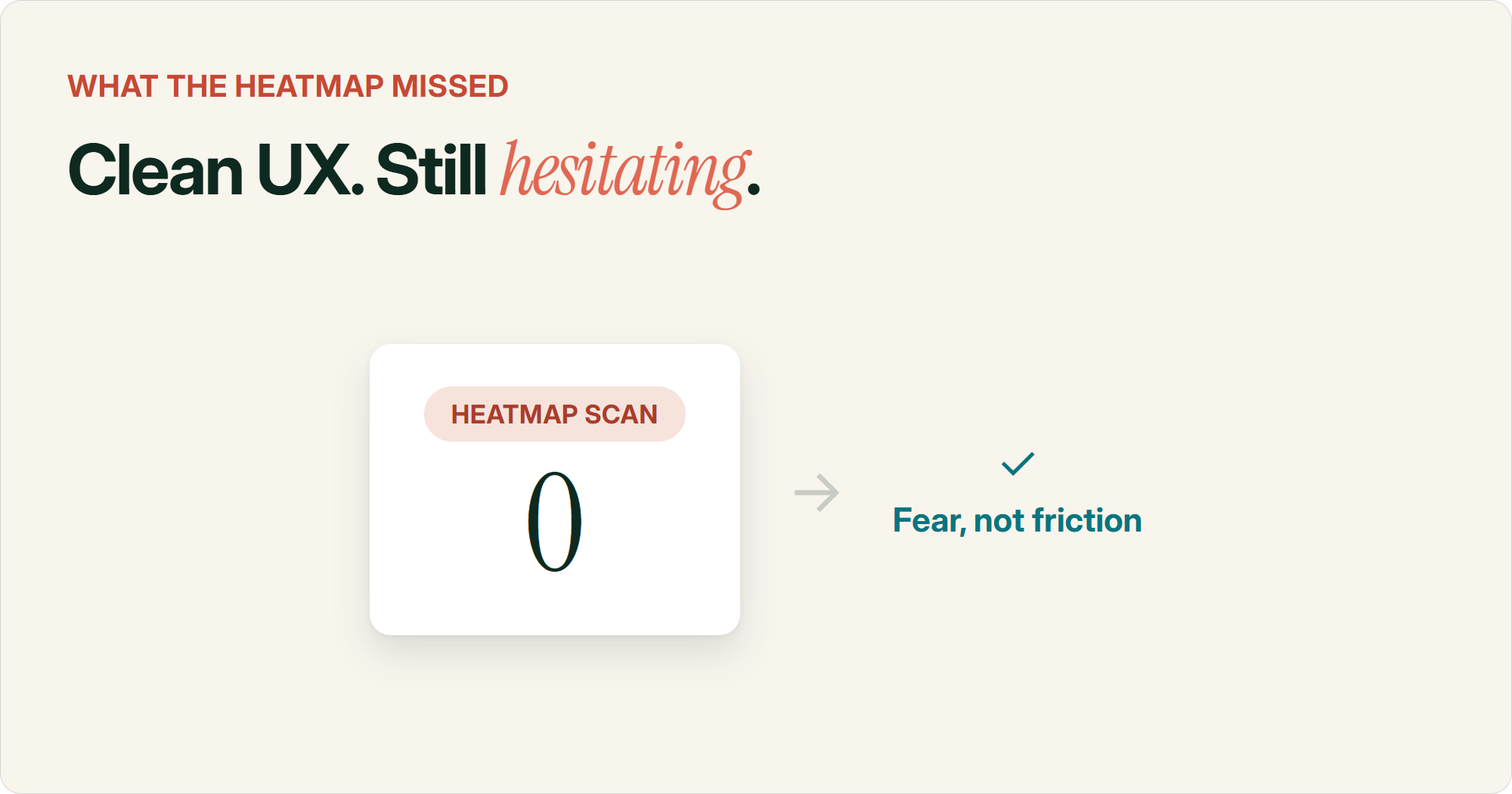
The reviews weren't complaining about the site. They were talking about their kids, their worry, whether the product would actually do what it promised. None of that shows up in a heatmap.
I started reading it as psychology instead of UX feedback, and that's when I realised we were missing an entire layer of the puzzle.
What Was Wrong With the Framework We Started With?
We weren't starting from nothing.
There's a common framework a lot of CRO agencies use to categorise the emotional drivers behind a purchase: security, comfort, belonging, progress, autonomy, curiosity and status.
It's a solid start. But once you start coding real reviews against it, you notice how much doesn't fit anywhere.
A review from a parent saying they bought something to protect their kid isn't security. Security is the buyer protecting themselves. This is someone protecting a person they love, and forcing it into the security bucket miscodes the entire review.
Same problem with "such good value for the price." Nowhere to put it. Same with identity language like "this is so me." Same with anyone buying because a brand's ethics lined up with their own.
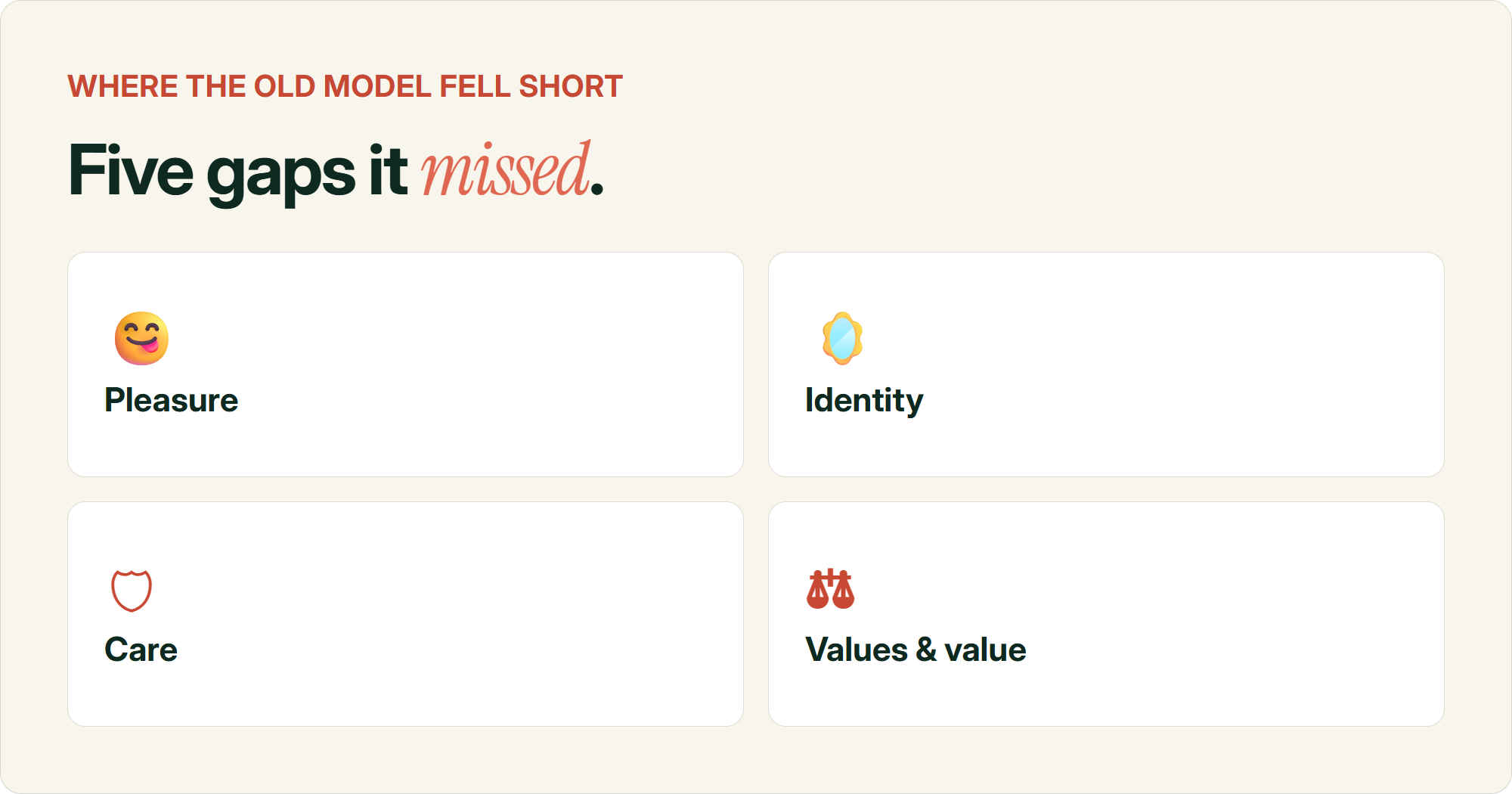
😋 Pleasure Buying because it feels amazing, not just because it works🪞 Identity Buying because it reflects who the customer actually is🛡️ Care Buying to protect or provide for someone else, not themselves⚖️ Values and Value Buying on principle, or buying smart. Easy to mix up, completely different drivers
I pulled every major taxonomy of human motivation I could find, twenty five plus of them across academic psychology and consumer research (Reiss, Schwartz, Murray, Häusel's Limbic Map, stuff like that), and mapped where they overlapped.
Five gaps kept showing up across multiple independent frameworks. Those five became the new buckets, taking that 7-driver model to our 12.
What Are the 12 Motivators?
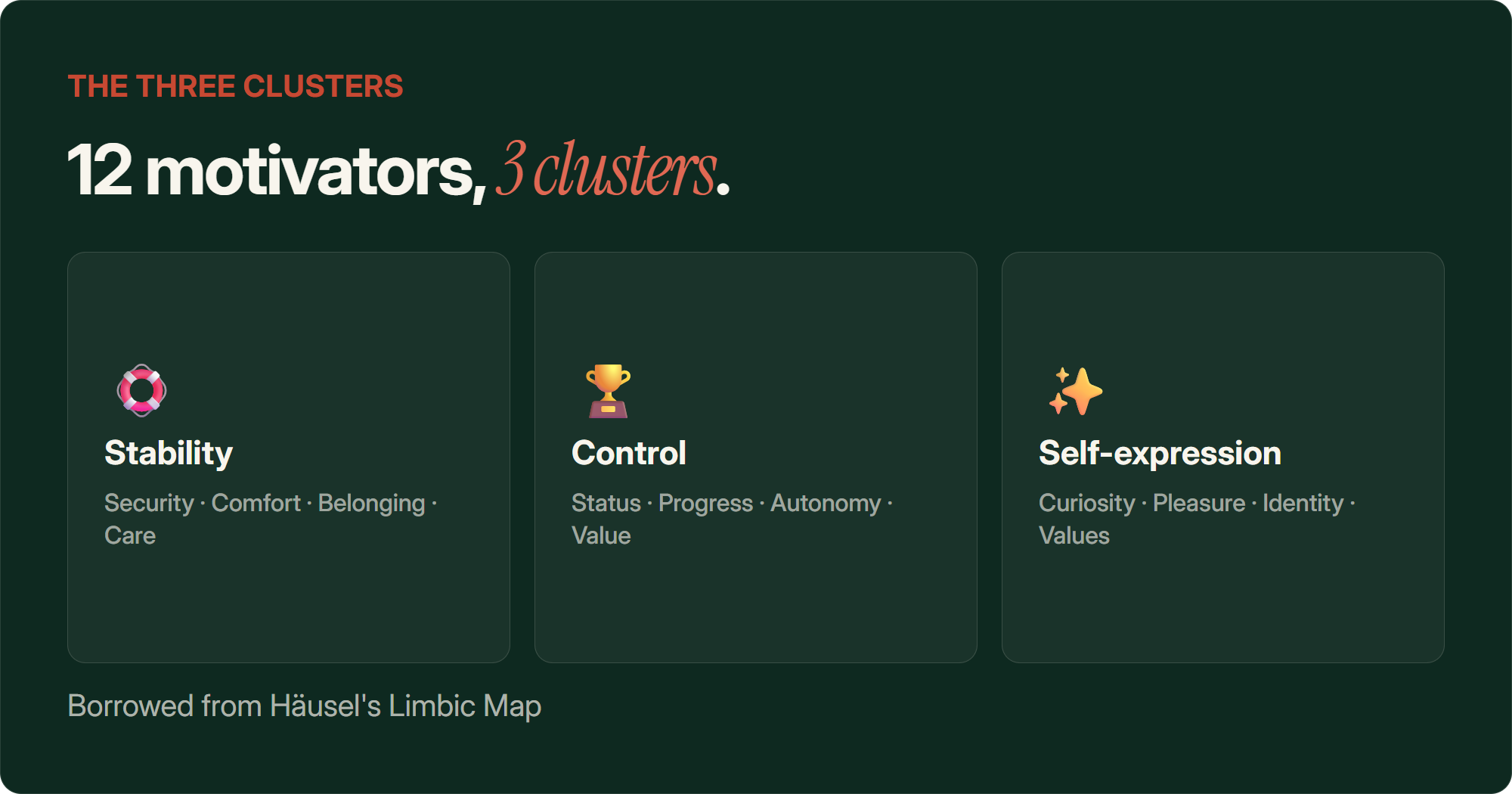
The 12 buckets split cleanly into three groups once you notice the pattern, borrowed from a piece of neuromarketing theory called the Limbic Map.
Security, comfort, belonging and care are all about stability. Someone wants to feel safe and looked after.
Status, progress, autonomy and value are about control. Someone wants to feel like they're winning, or like they got the smarter deal (we've written before about how pricing psychology plays out in tests, and value is a big part of why).
Curiosity, pleasure, identity and values are about self-expression. Someone wants to feel something new, or wants to feel like themselves.
🛟 Stability Security, Comfort, Belonging, Care. The customer wants to feel safe or looked after🏆 Control Status, Progress, Autonomy, Value. The customer wants to feel like they're winning✨ Self-Expression Curiosity, Pleasure, Identity, Values. The customer wants to feel something new or feel like themselves
You can see all three clusters at work in brands you already know. Costco's entire pitch is a control play, specifically value: you did the maths, and buying in bulk is objectively the smarter move. Harley-Davidson leans hard into stability through belonging. Their marketing barely mentions horsepower. It's about who you become when you ride with a million other people wearing the same patch.
Customers rarely score high on just one bucket. Most profiles land on two or three dominant motivators, and the neighbouring ones in the same cluster tend to show up together. Someone chasing curiosity is also likely chasing pleasure. Someone anchored in security is also chasing comfort.
That clustering is genuinely useful for sanity checking your own coding. If a customer profile comes back high on both security and curiosity at the same time, something's probably off, because those two pull in opposite directions.
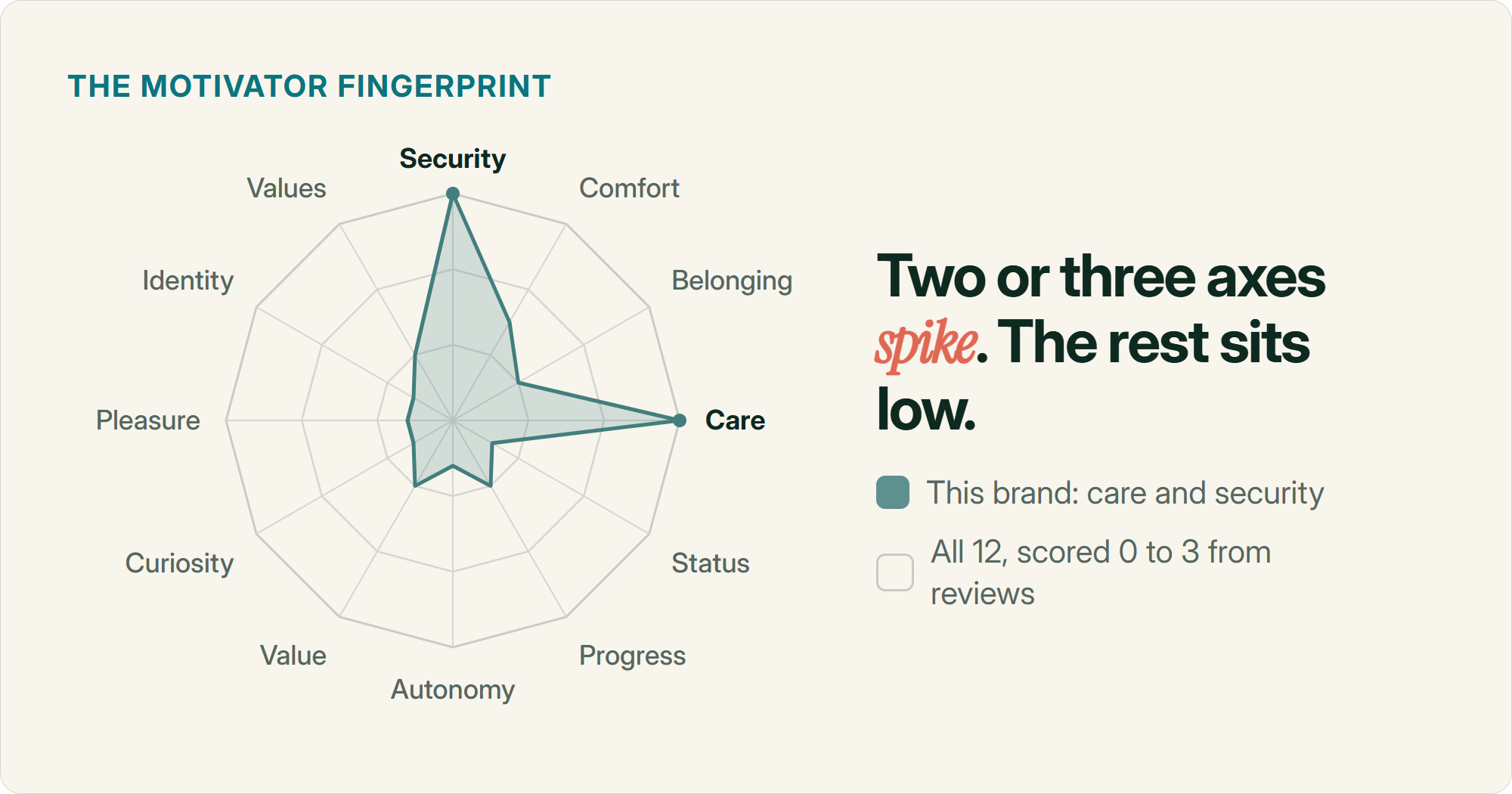
When you plot a brand's scores across all 12, you get something that looks like a fingerprint. Most of the axes sit low and two or three spike hard. The parent brand I mentioned earlier looks exactly like this, with care and security pushed right out to the edge and everything else barely registering.
What Does Each of the 12 Motivators Actually Mean?
Naming the 12 is the easy part. The useful part is knowing what each one actually looks like in a real review, and what you'd change on a page once you spot it.
So here's all 12, grouped by cluster, with the kind of language that gives each one away and what it usually means for how someone buys.
The first four are the stability motivators. This is the customer wanting to feel safe and looked after.
Security: will this protect what matters to me?
The customer is protecting themselves and their world. Their identity, their health, their family, their lifestyle. Anything they'd hate to lose.
Volvo built a whole brand on it. So has every extended warranty and identity-theft service ever sold.
This buyer wants proof nothing will go wrong before they commit. Guarantees, easy returns, clear warranty terms, the little security badges on the payment page. Anything that takes the risk out of saying yes.
Comfort: just make my life easier
The customer wants less hassle in their actual life. Less effort, and a lot less admin.
Amazon's 1-Click is about the purest example there is. So is any subscription that quietly shows up on your doorstep so you never have to reorder.
Sell the easy life to this one. Auto-replenishment, done-for-you setups, one-tap reorder, set it and forget it. Amazon's conversion rate went from around 2.5% to over 10% after 1-Click launched, and that was comfort doing the work.
Belonging: will this make me feel more like the person I see myself as?
The customer wants to be part of a group that matches how they see themselves. Being around those people makes them feel more like the person they already picture in their head.
Harley riders are the textbook case. CrossFit is another one. The product doubles as a membership card.
Show them the tribe. Customer photos and community numbers, that "join 40,000 others who switched" line. The thing they're really buying is belonging, and the product just comes attached to it.
Care: I'm buying this for someone I love
The customer is protecting or providing for someone else. The money isn't the thing at stake here, the person is.
It's the parent from earlier, terrified the product won't actually work for their kid. Or the adult child buying supplements for an ageing parent.
Speak to the person being cared for, not the buyer. Reassure them it's safe and it genuinely works, because a let-down here costs them a lot more than a refund could ever fix.
The next four sit in the control cluster. Here the customer wants to feel like they're winning, or that they outsmarted the situation.
Status: will this make people see me as successful?
The customer wants to be seen as successful or ahead of the pack. The purchase is a signal aimed squarely at other people.
Rolex. The "Pro" tier nobody strictly needs, the logo turned deliberately outward.
Position up. Premium framing and limited availability, "the best" rather than "the cheapest". Slapping a discount on a status product can actually put this buyer off, because the price was half the point.
Progress: this gets me closer to a goal
The customer wants to feel like they're moving forward. Improving and levelling up, getting somewhere they weren't before.
Duolingo streaks live here. So does a fitness tracker, or a free-shipping bar creeping toward "unlocked".
Show forward motion. Progress bars, milestones, streaks, honest before-and-after shots. Merchants report 15-30% AOV lifts from a free-shipping progress bar on its own, because it quietly turns a purchase into a goal.
Autonomy: let me do it my way
The customer wants control and independence. To choose and customise, and to never get locked into anything they can't walk away from.
Build-your-own everything. "Cancel anytime", or the tool that lets you export your data and leave whenever you feel like it.
Hand them the wheel. Configurators, flexible plans, easy exits, no-lock-in messaging. This buyer gets twitchy the second something starts to feel like a trap.
Value: this is the smart buy
The customer wants to feel like they got the smarter deal. Not cheap. Smart.
Costco is the whole personality here. You did the maths, bulk obviously wins and you feel a bit clever for it.
Do the maths for them. Cost-per-use, bundle savings, unit pricing, a clear anchor to compare against. The feeling you're selling is "I'm nobody's fool", which is a completely different thing from "this was cheap".
The last four are self-expression. This is the customer wanting to feel something, or feel like themselves.
Curiosity: I want to try something new
The customer wants novelty. To discover something and experiment, to see what it's actually like.
Limited-edition drops. A weird new flavour, or the subscription box where half the fun is not knowing what's coming.
Lean into new. "Just launched" and short limited runs, the "be the first to try it" angle. This buyer is a little bored, and boredom is the actual thing you're solving for them.
Pleasure: because it feels amazing
The customer wants to feel good. Sensory enjoyment, and a small hit of indulgence.
The stupidly expensive chocolate. The skincare that turns a bathroom into a spa for ten minutes, or anything you buy purely because it's lovely.
Sell the feeling, not the spec sheet. Sensory language and "treat yourself" framing, the experience of actually using it. Nobody buys a $12 bar of chocolate for its cocoa percentage.
Identity: this is so me
The customer buys things that reflect who they actually are. The product works like a mirror.
Liquid Death, for people who reckon bottled water is boring. Band merch, or the brand you wear because it says something true about you without you having to.
Reflect them straight back. A strong point of view and a "for people who" line, a personality they can borrow for themselves. A beige brand can't sell identity to anyone.
Values: this lines up with what I believe
The customer buys on principle. Ethics, sustainability, where a thing is made, who it puts money behind.
Patagonia telling you not to buy the jacket. Cruelty-free beauty, or choosing the local option on purpose even when it costs more.
Show the principle and then prove it. Real sourcing and a real mission, actual receipts instead of a vague "we care about the planet". This buyer can smell a hollow claim from a mile off.
How Do You Actually Run This Analysis?
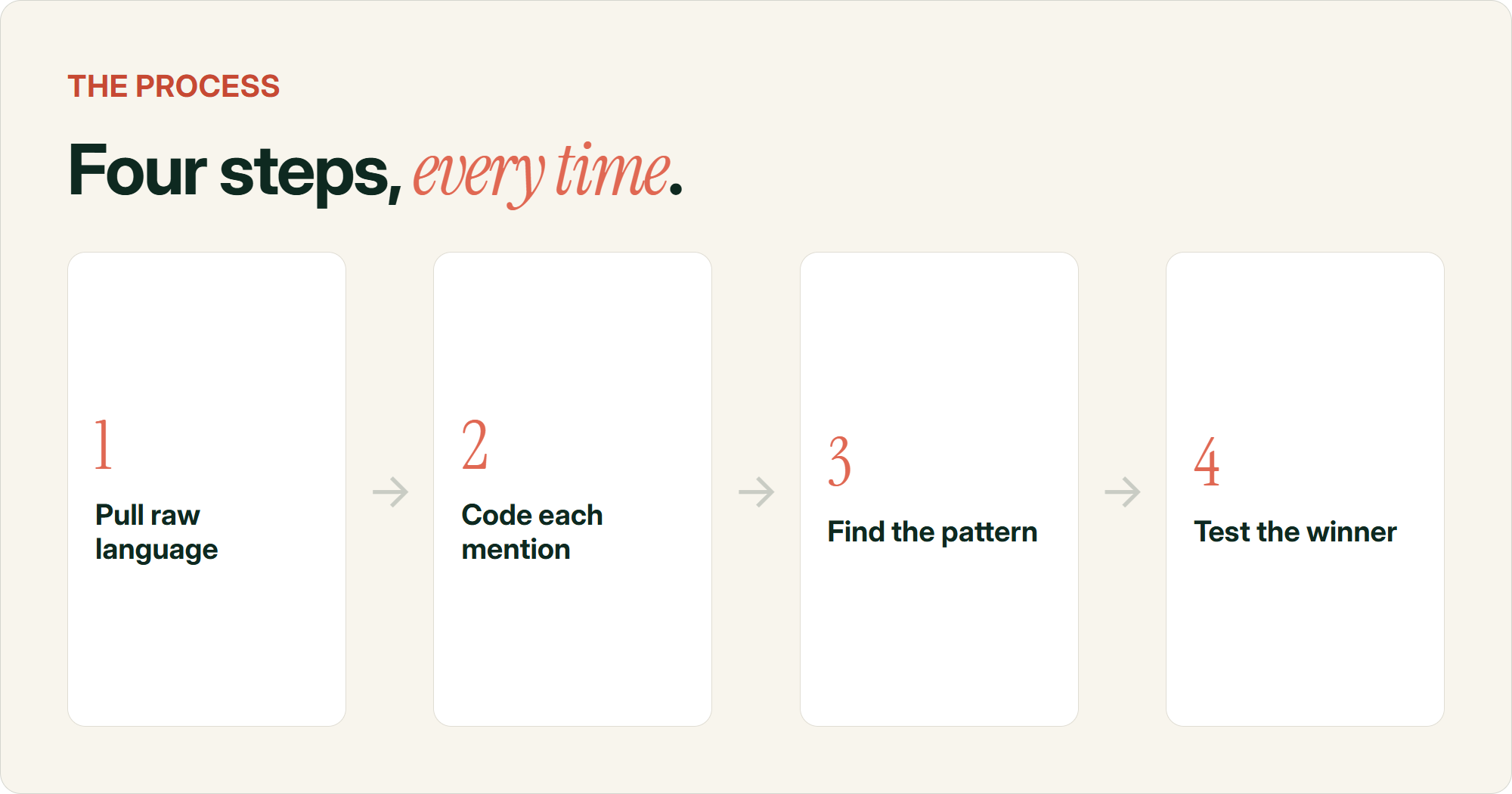
The process itself isn't complicated. It's just slow.
We start by pulling every piece of customer language we can get our hands on. Product reviews, Reddit mentions, social comments, anything where someone's talking about the brand in their own words rather than answering a survey question.
Pull the raw language Reviews, Reddit mentions, social comments, anything in the customer's own wordsCode each mention Tag which of the 12 motivators shows up in the language, and how stronglyFind the dominant pattern Most customer bases land on two or three motivators that keep repeatingTest against it Build a message or page change that speaks directly to the dominant motivator
Someone reads through it, review by review, and tags which of the 12 motivators shows up and how strongly. We score it on a simple 1 to 3 scale. A single review often codes to two buckets. The parent-safety review from earlier would code primarily to care and secondarily to security, because the product still needs to actually work.
One caveat worth flagging. What people write in a review isn't always what's actually driving them. A review obsessing over quality and durability might really be masking a status motivation, the customer wanting the best, not just the safest. We code the explicit language first, then sanity check it against everything else we know about the buyer.
Once you've coded enough reviews, a pattern falls out. Most customer bases land on two or three motivators that show up again and again, with everything else appearing occasionally or not at all. That's the profile, and it's what we test against.
What Happened When We Tested It?
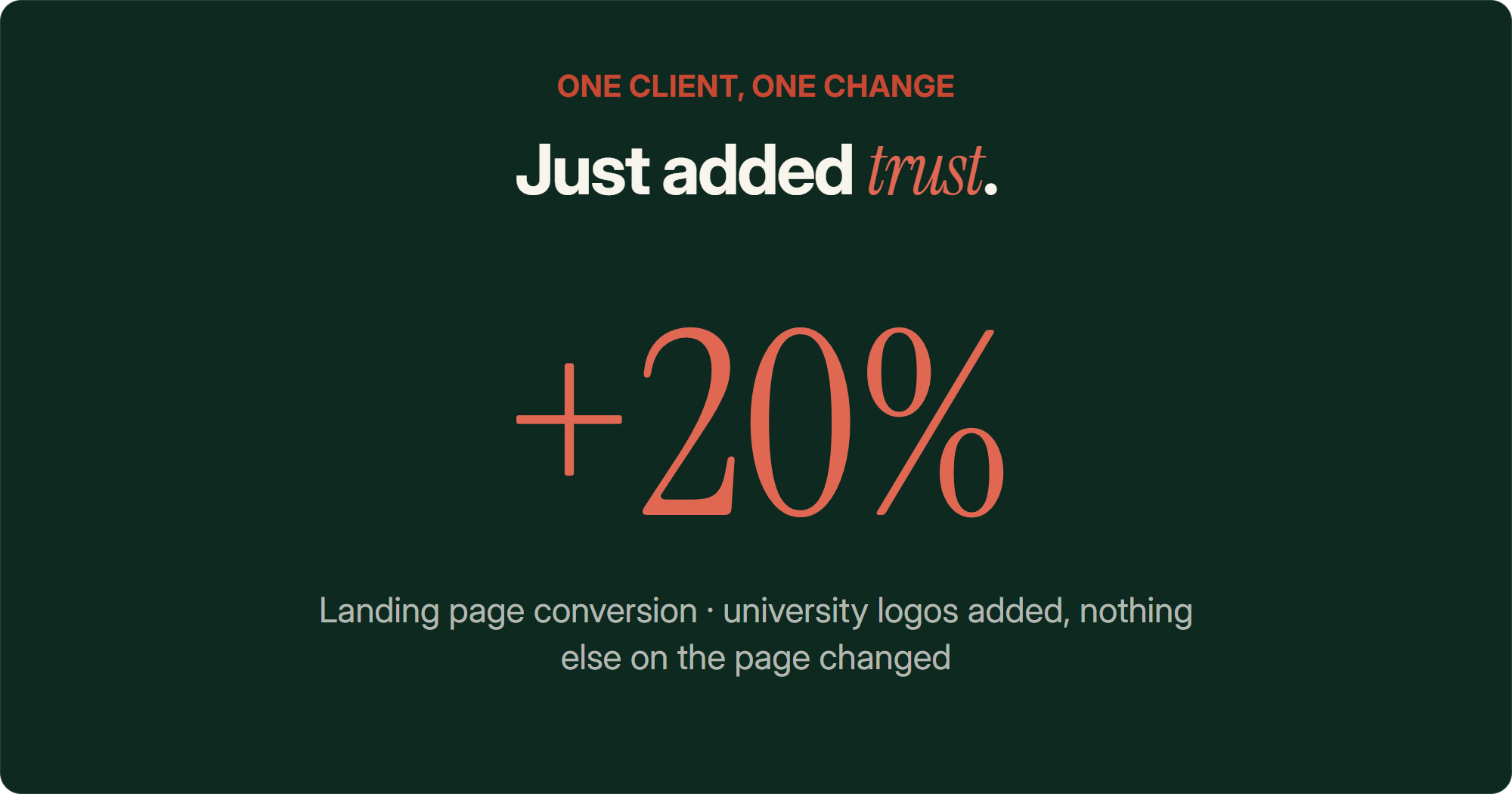
The clearest proof of this came from a client whose customers kept using language about trust and reassurance.
Not in a generic "is this safe" way. In a specific, detail-hungry way. People wanted proof and evidence the product actually did what it claimed before they'd commit.
So we added university logos to the homepage. Nothing else changed. Just logos linking to studies the company had already run, sitting above the fold.
+20% Landing page conversion rate lift from adding university logos, with nothing else on the page changed
This was a customer who needed reassurance and got it. The page wasn't confusing before, and the button wasn't hard to find. Every lever in the standard CRO toolkit would have missed this completely, because there was no friction to remove. It's the same kind of non-obvious win we found when we went hunting through a client's numbers for hidden revenue, just coming from a completely different direction.
You see the same pattern in brands way bigger than any of our clients, just running on different buckets.
2.5% → 10%+ Amazon's conversion rate after 1-Click checkout (comfort)15-30% Typical AOV lift merchants report from a free-shipping progress bar (progress)
Different motivators, different mechanisms, same lesson. None of it is a UX fix. It's psychology, dressed up as a page element.
How Can You Run This on Your Own Store?
You don't need us to do this. You need patience and a spreadsheet.
Pull fifty to a hundred reviews from your best-selling products. Read them slowly, and every time someone's language points at an emotion rather than a feature, write down which of the 12 it sounds closest to.
How to try this yourself
Pull 50-100 reviews from your best-selling products. For each one, note whether the language points at safety, ease, belonging, achievement, control, discovery, status, delight, self-expression, care for someone else, ethics or price-smarts. Tally it up. The two or three that repeat most are your dominant motivators, and that's what your homepage and ads should be speaking to.
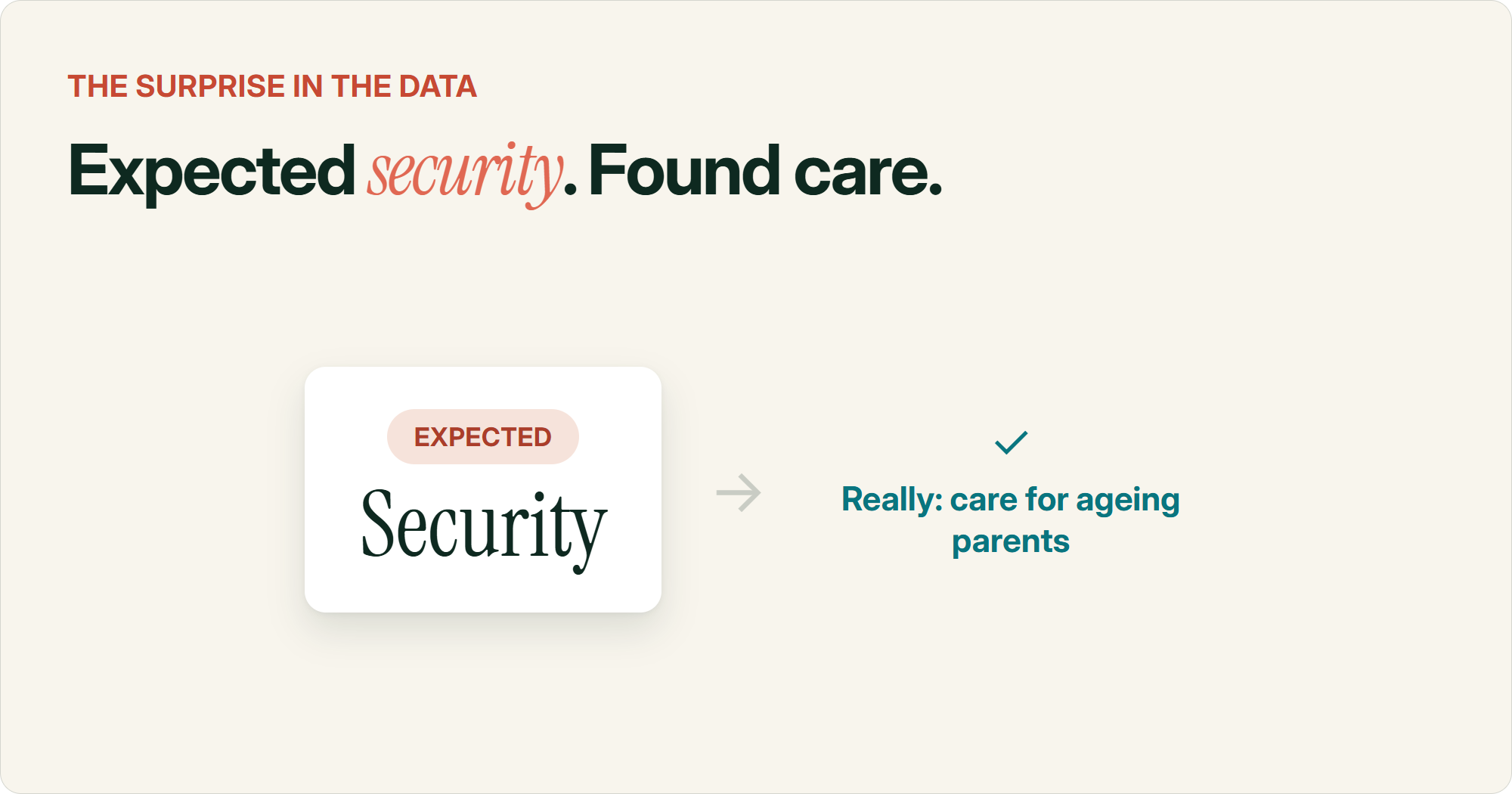
Do that for a hundred reviews and a pattern will show up on its own. Most brands are surprised by what dominates. A supplement brand might expect security and actually be running mostly on care, because it turns out most of the buyers are adult children buying for ageing parents.
You won't find that in a heatmap. You'll find it in the way people write about you when nobody's asking them to.
I've been doing CRO for a while now, and testing psychology instead of just friction has been the biggest shift in how we find experiment ideas in years.
Most of what's left to fix on a mature store comes down to one thing. You don't actually know why your customers are buying, only that they are.
Common questions about the 12 motivators framework
What's the difference between this and the common 7-driver model?
The standard 7 (security, comfort, belonging, progress, autonomy, curiosity, status) cover a good chunk of purchase psychology but miss entire categories that show up constantly in real reviews. Buying to protect someone else, buying because something feels amazing, buying on ethics, buying because it reflects your identity and buying because it's smart value all get miscoded or lost under that model alone. The 12-point version adds those five.
How is this different from a standard customer persona?
Personas usually describe demographics: age, income, location, maybe a few interests. This framework skips demographics and codes the actual emotional language customers use about your product. Two customers can look identical on a persona and still be driven by completely different motivators, one buying on status and the other on value.
How many reviews do you need before the pattern is reliable?
Somewhere around 50 to 100 reviews is usually enough to see two or three motivators repeating. Below that the sample's too noisy and you'll chase whatever review you happened to read most recently. For a full client profile we usually code several hundred pieces of customer language across reviews and social platforms.
Does this replace A/B testing?
No, it feeds it. The framework tells you which psychological lever to pull. A/B testing tells you whether pulling it actually moved the numbers. We still run the test, we just stopped guessing at what to test once we started coding reviews this way.
Can this work for a brand with barely any reviews yet?
It's harder, but not impossible. Pull whatever customer language exists, including support tickets, social comments, sales call notes and even old customer service emails. If a brand genuinely has almost nothing, run the analysis on its closest competitors instead. The motivators driving a category usually overlap heavily between a brand and whoever it's up against.
Sources
- 16 Basic Desires (Reiss, 2000), Ohio State University
- Theory of Basic Human Values (Schwartz, 1992), validated across 82 countries
- Psychogenic Needs (Murray, 1938), the original comprehensive motivation taxonomy
- The Limbic Map (Häusel), a neurochemistry-based consumer motivation model
- Amazon's One-Click Checkout UX Case Study, Rock Paper Scissors Studio
- Free Shipping Progress Bar Guide, Elite Cart