 Talk to a human
Do Countdown Timers Actually Work on Ecommerce Sites?

I spent about a decade believing countdown timers were close to magic, off the back of a business where I never once tested the timer.
Before I ran my own agency I worked with an ecommerce brand that had a genuinely weird model. They'd pull together 2,000 or so affiliates to compile a collection of resources. Mostly ebooks, with a few other bits and pieces in there. Then they'd sell the whole bundle for 5 to 7 days and take it down.
The site had a big dirty timer that followed you around everywhere you went.
Conversion rate was high. The revenue was big for how small that business actually was. And every single sale, the biggest spike came in the last few hours before the clock hit zero.
I put that down to the timer.
What I actually had was a correlation and a strong feeling about it, and I carried that around for years as though it were a finding.
So I went and dug through this properly. Published split tests, the academic literature, the regulator guidance, a pile of Shopify merchant threads.
The short version is that countdown timers work sometimes, and the thing that decides it has almost nothing to do with the timer.
The evidence is thinner than you'd hope
I expected to find a stack of case studies. There isn't one.
I could source seven ecommerce A/B tests on countdown timers. Seven. And not a single one of them publishes sample size, duration and significance together, so every number you're about to read is directional at best.
The two biggest wins are both delivery deadlines.
Conversion Rate Experts got +27% orders for daFlores, a flower delivery business, using a clock plus the message "order in the next n hours for delivery today" on category pages. Flowers for an occasion, so the customer already had a deadline before they landed on the site.
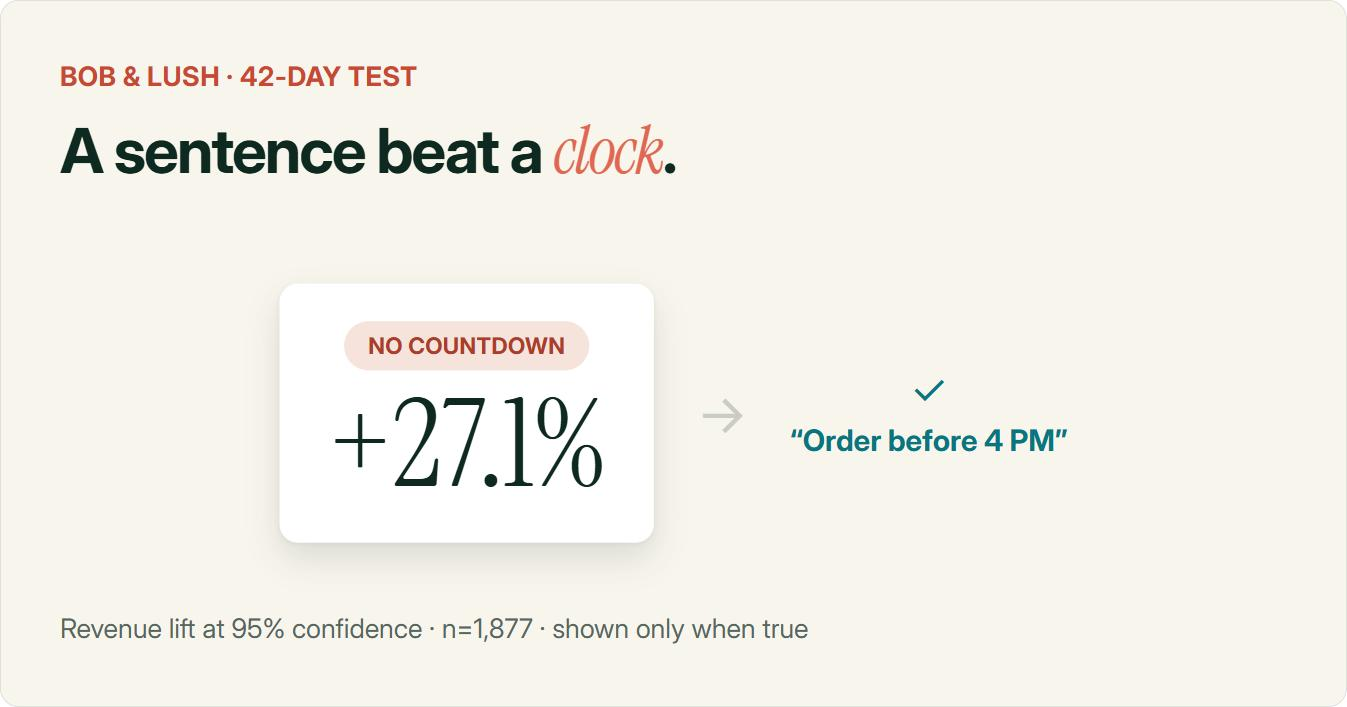
The other one is more interesting. CXL ran a 42-day test on Bob & Lush, a UK premium dog food brand, back in 2015. They'd surveyed customers and found the main anxiety was running out of food before the next delivery arrived. So they added one line just under the product name: "Free next business day delivery if you order before 4 PM (UK)".
Revenue went up 27.1% at 95% confidence.
There was no clock. It was a sentence. And it was conditionally rendered so it only showed on weekdays, before 4pm, to UK visitors, which meant it was never lying to anyone.
The published losses are just as instructive. Recart tested a countdown on an email opt-in popup and it hurt signups on desktop and mobile, which they published themselves despite selling popup software. A "Product in High Demand" alert at checkout decreased conversions.
Then there's the lab work, which is grim reading if you sell timer apps.
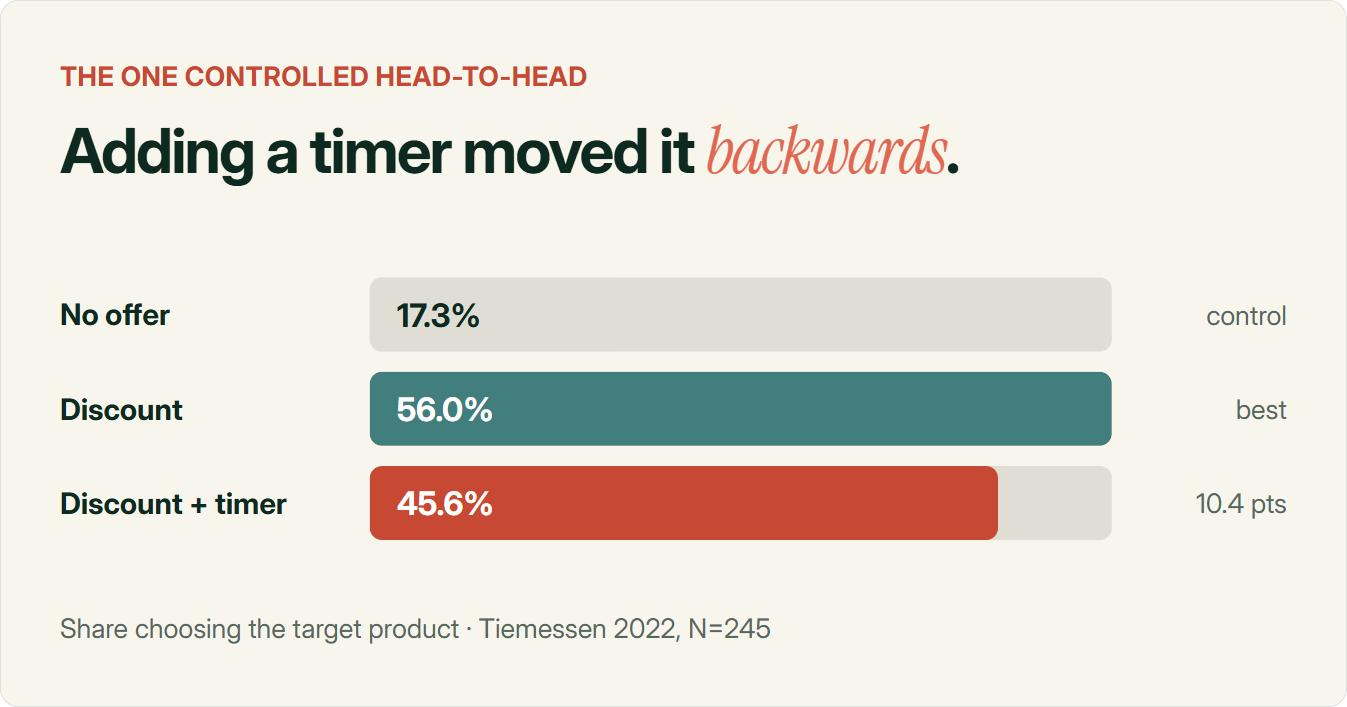
Two controlled experiments found no lift at all. Luguri and Strahilevitz ran a census-weighted US sample of 3,777 people and found countdown timers "did not significantly increase consumer purchases", while other dark patterns in the same study worked hard. And Jelmer Tiemessen's thesis ran 245 people across three arms buying the same office chair.
The discount did all the work. Bolting a timer on top moved it slightly backwards.
You could argue these are lab studies with hypothetical money and no brand equity at stake, and you'd be right. So I hold them loosely. What they did change is my willingness to quote a confident percentage to anybody.
Because the other thing I found is that pretty much every double-digit stat floating around this topic is fabricated. There's a "+14% conversion, per Baymard" figure on dozens of app vendor pages. It does not exist anywhere in Baymard's research. Same story with "+332%", "8-18%", "15-30%" and a "68% of shoppers feel manipulated" stat that traces back to nothing at all.
The deadline does the work
The courier van reframed this one for me.
If your warehouse gets picked up at 4pm, that deadline exists whether or not you display it. Orders in before 4 go out today. Orders after 4 don't. Conversion naturally climbs toward that cutoff because the deadline is real and some people know about it already.
You can show that deadline as a ticking clock. You can show it as a sentence. Bob & Lush showed it as a sentence and got 27.1%.
The timer displays a deadline. The deadline does the work.
Which sounds obvious written down, and yet the entire app category is built on selling you the display mechanism without asking whether you have anything to display.
The research backs this harder than I expected. Hmurovic, Lamberton and Goldsmith published a paper in the Journal of Marketing Research looking specifically at time-scarcity promotions in online retail. They found the positive effects that show up offline don't reliably show up online at all. In one experiment comparing channels directly, the time-limited offer lifted willingness to pay in a physical store and did nothing on a website.
The reason they landed on is persuasion knowledge. Online shoppers have seen so many of these that a deadline reads as information about the seller's motives rather than information about the offer.
And the fix they found is the useful part. Deadlines attributed to something outside the retailer's control worked. A public holiday. A seasonal changeover. Arbitrary deadlines did nothing.
A 2025 Journal of Retailing paper arrived at the same remedy independently while studying low-stock cues. Two different teams, two different cue types, same answer.
The question to ask before installing anything
Skip "should we add a countdown timer" and ask "what deadline do we already have that customers don't know about". Courier cutoffs, production runs, restock dates, season changeovers. If the answer is nothing, the timer has nothing to display.
Timers do nothing for a lot of products
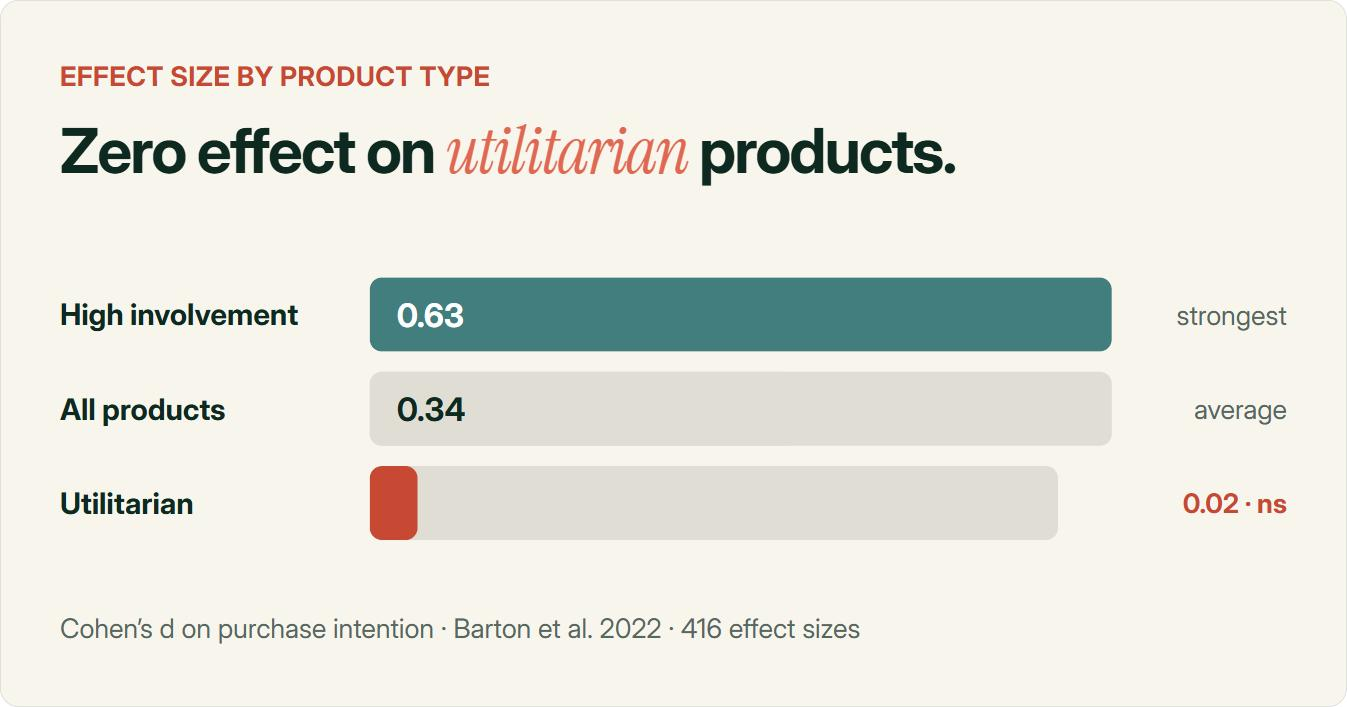
The best quantitative work here is a 2022 meta-analysis in the Journal of Retailing by Barton, Zlatevska and Oppewal. They pooled 416 effect sizes from 131 studies on product scarcity.
Time-based scarcity comes out at a Cohen's d of 0.34 on purchase intention. Small to moderate, and roughly the same as low-stock and high-demand cues, which are statistically indistinguishable from it.
The moderators are far more useful than the headline.
For high-involvement products the time effect jumps to 0.63. For low-involvement products it drops to 0.20 with a confidence interval that crosses zero, so it isn't reliably different from doing nothing.
For utilitarian products it's 0.02. Nothing. Statistical zero.
That inverts what I'd assumed for a long time, which was that urgency belongs on cheap impulse stuff. The literature says the opposite. On a low-consideration item there's no deliberation happening, so there's nothing for the deadline to interrupt.
Scarcity effects also run about double for unfamiliar brands (0.41) versus familiar ones (0.21). Which is an awkward one, because the brands with the most trust equity to lose get the smallest lift.
There's a related finding from Dhar and Nowlis in the Journal of Consumer Research that I keep thinking about. They put people under time pressure and measured how often they chose to defer, which is the academic version of "I'll think about it".
When the shopper faced a genuine trade-off between two options that each won on something different, deferral dropped from 36% to 21%. When one option was clearly better, it went from 22% to 22%. No change at all.
So a timer has the best shot on a page where someone is genuinely torn between variants or bundles. On a single hero SKU with no real internal decision, the mechanism has nothing to bite on.
Worth testing a timer Best case
- Considered, higher-involvement purchases
- Hedonic categories like jewellery, fragrance, apparel, gifting
- Pages where the shopper is torn between two or more options
- A real dispatch cutoff or a sale that genuinely ends
- Newer brands the shopper has no prior read on
Don't bother Predicted flat or negative
- Utilitarian products, where the measured effect is zero
- Low-ticket impulse catalogues
- Single hero SKU with no real choice to make
- Sustainable, craft or ethics-led positioning
- Deep in checkout, where the remaining friction is all downside
The cart timer problem on Shopify
This one is worth knowing even if you never plan to run a timer, because a lot of stores have one of these installed and nobody has checked what it does.
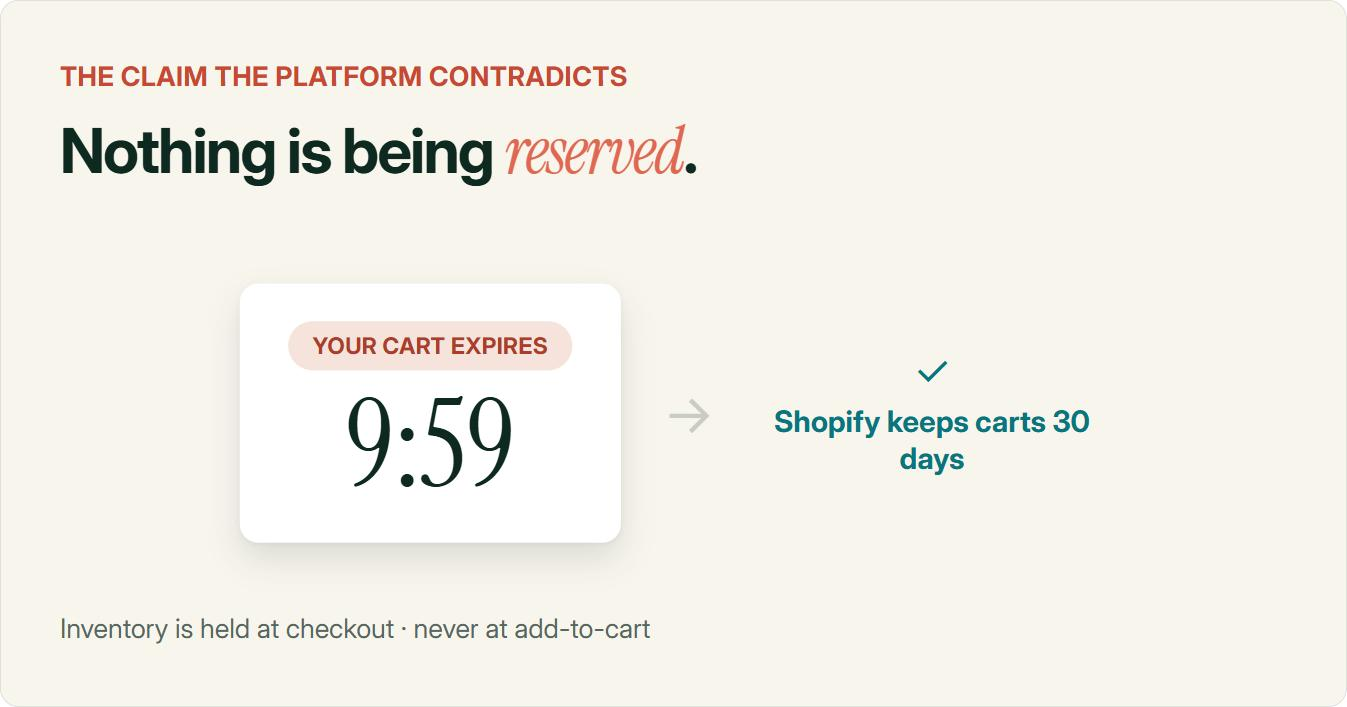
Shopify doesn't reserve inventory when someone adds to cart. Stock gets held at the final stages of checkout. And abandoned carts stick around for 30 days by default.
So "your cart expires in 9:59" is a claim the platform actively contradicts. The cart is still there in half an hour. It's still there next week.
Check this on your store today
Open your cart page in an incognito window. If a reservation timer restarts from its full value, it's session-based and it isn't connected to anything. Both of the big Shopify timer apps ship evergreen and session modes, and they're often the default.
Checkout is mostly off the table anyway. Checkout UI extensions on the information, shipping and payment steps are Shopify Plus only, and checkout.liquid was sunset for the Thank You and Order Status pages in August 2025. For most merchants the cart page is the last surface you actually control.
Which is probably fine, because urgency isn't the problem at that end of the funnel. Baymard's abandonment data puts unexpected extra costs at 39% of abandonment reasons. Forced account creation at 19%. A checkout that's too long or complicated at 17%.
Nothing on that list gets fixed by a clock. If you're losing people between cart and confirmation, the things that actually reduce cart abandonment are cost transparency and fewer steps.
What happens when people work out it's fake
Somewhere between 40% and 45% of live ecommerce countdown timers are fake, and three separate measurements agree on that.
The Princeton "Dark Patterns at Scale" crawl of 11,000 shopping sites found 157 of 393 countdown timers were deceptive, meaning the timer reset with the offer still valid or expired while the offer kept running. Tiemessen's 2022 corpus of 60 live sites found 27 of them faking it. And the European Commission's March 2026 sweep of 314 traders found 18% using pressure tactics, with over half of those deceptive.
This is what killed the airline version. There was a period where every flight booking site had four seats left and a blinking discount and 90 seconds to sort yourself out. They've largely disappeared, and I think it's because everybody figured out the seats weren't going anywhere.
Detection is cheap. Refresh the page, or open an incognito window, or just come back tomorrow and see if the sale that was ending in two hours is still running.
In Tiemessen's experiment, before anyone was told what the study was about, not one participant in the timer group named the countdown as a reason to buy. Five of them spontaneously said they picked the other product because the offer looked sketchy or fake. One wrote "it was the same chair so I chose the less 'sketchy' one".
And when people were asked whether timers influence them, the ones who said no mostly gave distrust as the reason rather than indifference. "I wouldn't believe the timer to be true, anyway."
The cost of that is bigger than it looks, and your A/B test can't see it.
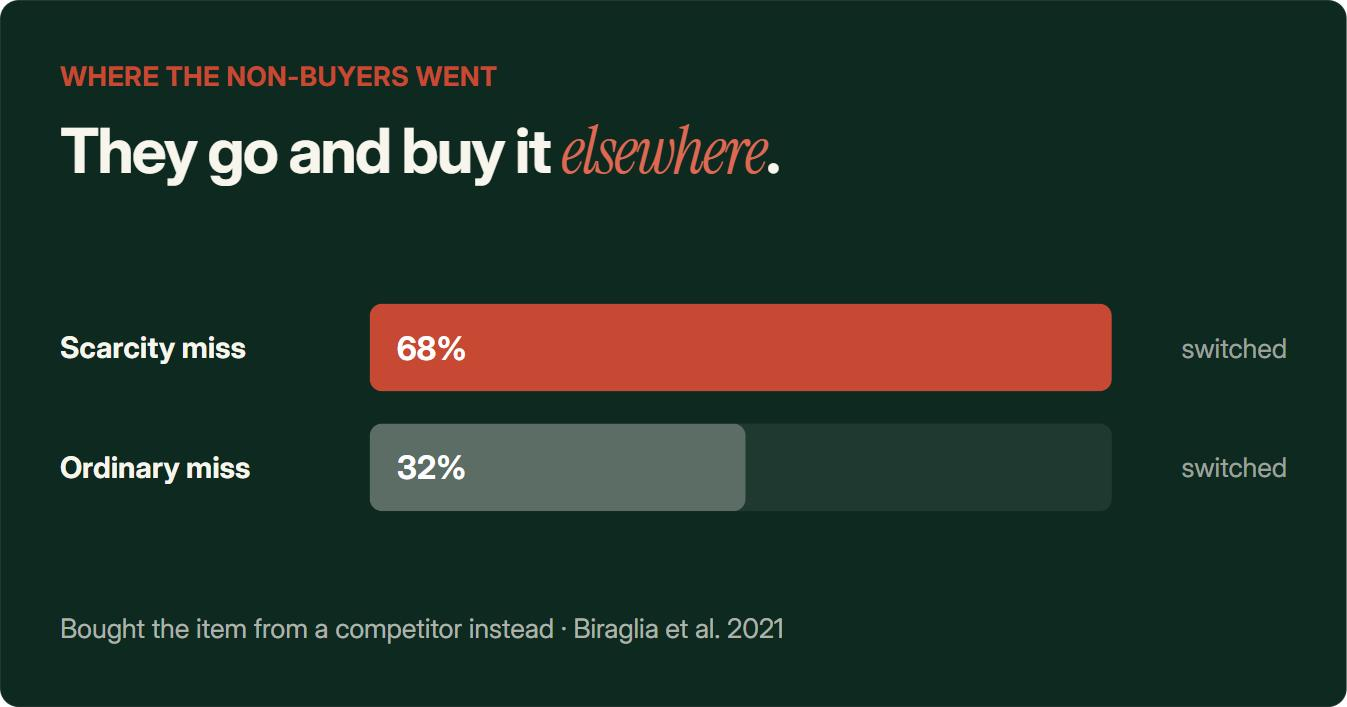
Biraglia, Usrey and Ulqinaku surveyed UK shoppers the day after Prime Day about items they'd tried and failed to buy. People who missed out because of an advertised scarcity constraint were angrier than people who missed out for other reasons, and the behaviour split hard.
Now that study looked at genuine stockouts rather than timers, so I'm extending it a bit. But the mechanism is non-acquisition under an advertised constraint, and a countdown timer manufactures exactly that for every visitor who doesn't buy before zero. On a normal store that's 95% plus of the people who see it.
The upside lands on the small group who convert. The downside lands on everyone else, next week, on somebody else's domain.
The legal position has also moved a long way in the last two years. In the UK, a resetting countdown clock is the regulator's own worked example of a banned practice under the Digital Markets, Competition and Consumers Act, with fines up to 10% of global turnover and the CMA enforcing directly since April 2025. It's per se illegal in the EU under the Unfair Commercial Practices Directive. Australia's new unfair trading regime names misleading countdown timers expressly, commencing July 2027 with penalties up to A$100m. And the New York AG already extracted $2.6m from Fareportal in 2022 for running booking countdowns while reserving nothing.
The UK guidance also has a trap in it that catches a lot of honest merchants. A technically true timer can still be misleading if a substantially similar offer turns up shortly afterwards. So ending the 20% off sale on Friday and starting a different 20% off sale on Monday doesn't get you out of it.
How I'd actually use one now
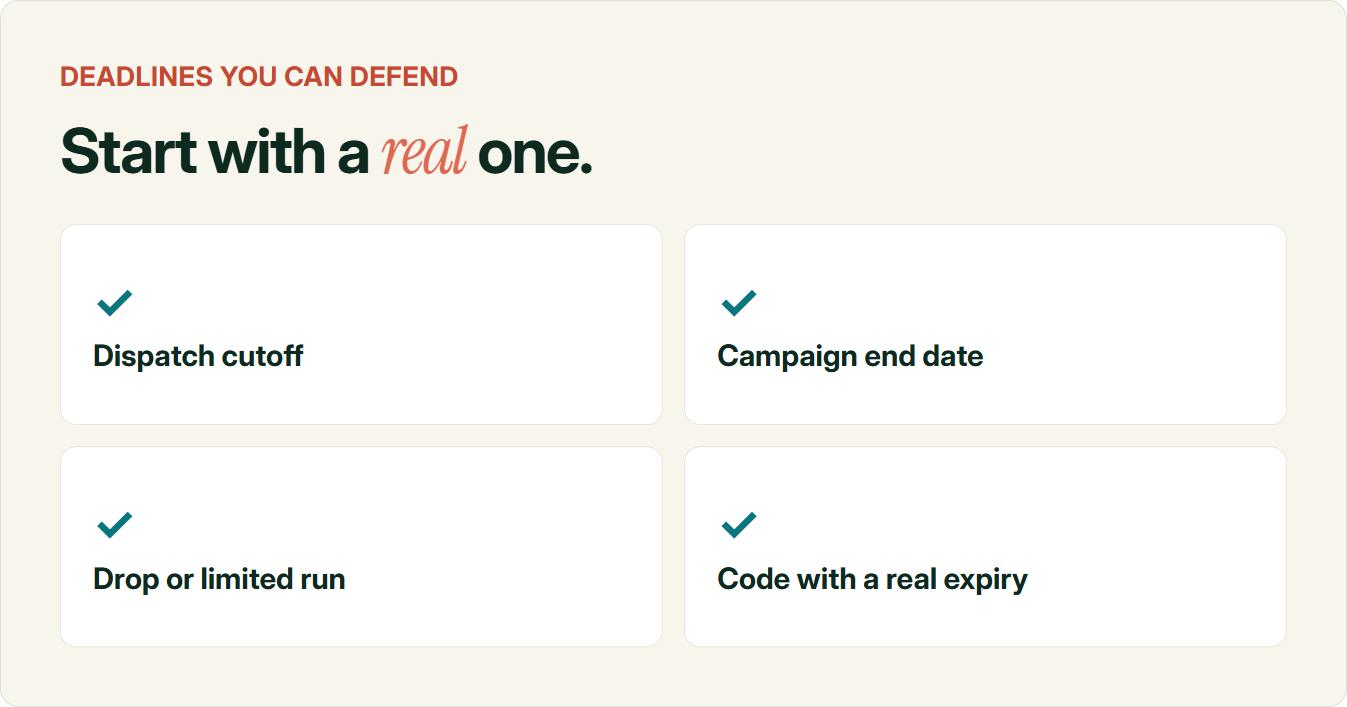
Start with the deadline. Find one that already exists in the business.
Dispatch cutoffs are the strongest option available to most stores, and they've got the best evidence behind them. The courier leaves at 4pm whether you like it or not, it's genuinely useful information for the customer, and it resets itself daily without anyone touching it.
After that: a campaign that genuinely ends, a drop or limited production run, a restock window, an abandoned cart code with a real expiry on it.
Then run the sale timer only in the last day or two. A six-day countdown does nothing on day six. All the pressure lives at the end, which is exactly what I watched happen on those bundle sales years ago.
And print the actual end date and time next to the clock. "Ends 11:59pm AEDT, Sunday 27 July" turns an unverifiable claim into something a customer can check, which is how you separate yourself from the 40-odd percent who are making it up.
Hard refresh the page If the timer restarts instead of continuing, it's client-side and it's fake.Open it in incognito and on your phone A real campaign deadline shows the same remaining time on every device. A session timer resets.Let it hit zero The price should actually revert and the banner should remove itself. If nothing changes, the deadline was decorative.Come back in a fortnight Same "ending soon" offer still running, or the same offer under a new name, means you've got a perpetual sale with a costume on.Check the stock counter too Regulators treat fake low-stock cues and fake timers as one category, so an honest timer next to a randomised counter fixes nothing.
The test I keep coming back to: could you screenshot your own store 60 seconds after the timer hits zero, and would that screenshot show a worse offer than the one before it?
If yes, you're fine everywhere. If no, it's a fake timer regardless of what you intended.
If you're going to test one, test it properly
The effect sizes here are small enough that the measurement problems are bigger than the thing you're measuring. If you're on a store that already struggles for enough traffic to run a clean A/B test, a timer is a poor candidate for one of your test slots.
Novelty will inflate your early read, because a loud new element pulls attention from returning visitors precisely because it wasn't there last week. Plot cumulative lift by day and segment new against returning. A real effect stays roughly flat. Novelty starts high and decays.
Watch for pull-forward. A timer works by accelerating a decision, so if somebody who would have bought Thursday buys Tuesday instead, your fixed-window test records a win with zero incremental revenue. Compare cumulative revenue past the end of the test, not just during it.
Read it on revenue per visitor, and on profit per visitor if there's a discount attached. One of the vendor case studies I found reported add-to-cart lift and nothing else, which is a great way to hide the fact that you moved the drop-off point instead of removing it.
Urgency compresses sessions too, so keep an eye on AOV. Fewer product views means fewer bundles and less threshold-chasing on free shipping.
Run whole weeks, minimum two to four of them, and don't stop early on a good-looking read. There's more on picking tests that actually move revenue if you want the broader version of this.
And segment it. There's a documented case in the scarcity literature of the same cue helping one group and hurting another, which nets out to a flat result if you only look at the average.
As for that bundle business I started with, I think it was probably fine. The window was real, the sale genuinely ended, the whole business model depended on the thing being unavailable most of the year. What I can't tell you, because I never checked, is whether the big dirty timer added anything over a line of text saying "closes Sunday".
I'd take that test now if I could go back.
Common questions about countdown timers on ecommerce sites
Do countdown timers increase conversion rate?
Sometimes, and by less than the app listings claim. The published ecommerce split tests cluster in the low single digits, and two controlled academic experiments found no significant lift at all. The wins in the record are attached to real deadlines like a delivery cutoff or a genuine sale window. Plan for 0-5% and size your test accordingly.
Where should a countdown timer go on a Shopify store?
The product page, near the price or add-to-cart button, tied to a dispatch cutoff. That's the only placement with credible attributed lift. Cart reservation timers are false on Shopify because the platform doesn't reserve inventory at add-to-cart, and checkout timers are unavailable to non-Plus merchants since checkout.liquid was sunset in August 2025.
Are fake countdown timers illegal?
Yes, in most markets a Shopify store sells into. A resetting countdown clock is the UK regulator's own worked example of a banned practice under the DMCCA, with fines up to 10% of global turnover. The EU treats it as unfair in all circumstances under the UCPD. Australia's incoming regime names misleading timers expressly from July 2027.
How long should a countdown timer run?
Let the real deadline set the duration. Dispatch cutoffs run to the courier pickup and reset daily. Campaign timers should really only appear in the final 24 to 48 hours, since a six-day countdown creates no urgency on day six. Short cart timers of 10 to 15 minutes are the highest-risk option because the platform can't honour them.
Are low stock counters better than countdown timers?
Usually, provided the number is wired to real inventory. In a head-to-head study a countdown timer was significantly more frustrating than a low-stock cue and was the only condition to damage perceived usability. Low-stock cues also pair properly with social proof like "12 people viewing", where time-based cues get nothing from it.
What's the difference between a countdown timer and a deadline?
The deadline is the constraint. The timer is one way of displaying it. A static line like "order before 4pm for same-day dispatch" produced a 27.1% revenue lift with no clock involved, which suggests the display format matters far less than whether the underlying constraint is real and useful to the shopper.
Sources
- Scarcity tactics in marketing: A meta-analysis of product scarcity effects on consumer purchase intentions. Barton, Zlatevska and Oppewal, Journal of Retailing, 2022
- Examining the efficacy of time scarcity marketing promotions in online retail. Hmurovic, Lamberton and Goldsmith, Journal of Marketing Research, 2023
- The effect of time pressure on consumer choice deferral. Dhar and Nowlis, Journal of Consumer Research, 1999
- The downside of scarcity: Scarcity appeals can trigger consumer anger and brand switching intentions. Biraglia, Usrey and Ulqinaku, Psychology & Marketing, 2021
- Dark Patterns at Scale: Findings from a Crawl of 11K Shopping Websites. Mathur et al, ACM CSCW, 2019
- Shining a Light on Dark Patterns. Luguri and Strahilevitz, Journal of Legal Analysis, 2021
- The Time is Ticking: The Effect of Deceptive Countdown Timers on Consumers' Buying Behavior and Experience. Tiemessen, Radboud University, 2022
- Implementing Urgency on Ecommerce Product Pages for a 27.1% Lift. Speero and CXL, 2015
- daFlores case study. Conversion Rate Experts
- Gamified countdown timer test. Recart Laboratory
- Cart abandonment rate statistics. Baymard Institute
- EU check reveals misleading sales practices online. European Commission, March 2026
- Unfair commercial practices guidance CMA207. Competition and Markets Authority, November 2025
- When product scarcity backfires (or doesn't): Limited quantities affect perceived retailer sincerity in online promotions. Journal of Retailing, 2025